Matrimony Fraud in India: How It Happens, Real Warning Signs, and How to Stay Safe
Over ₹500 crore is lost to matrimony fraud in India every year. Understanding how it works, and what to watch for, is the first step to protecting your family.
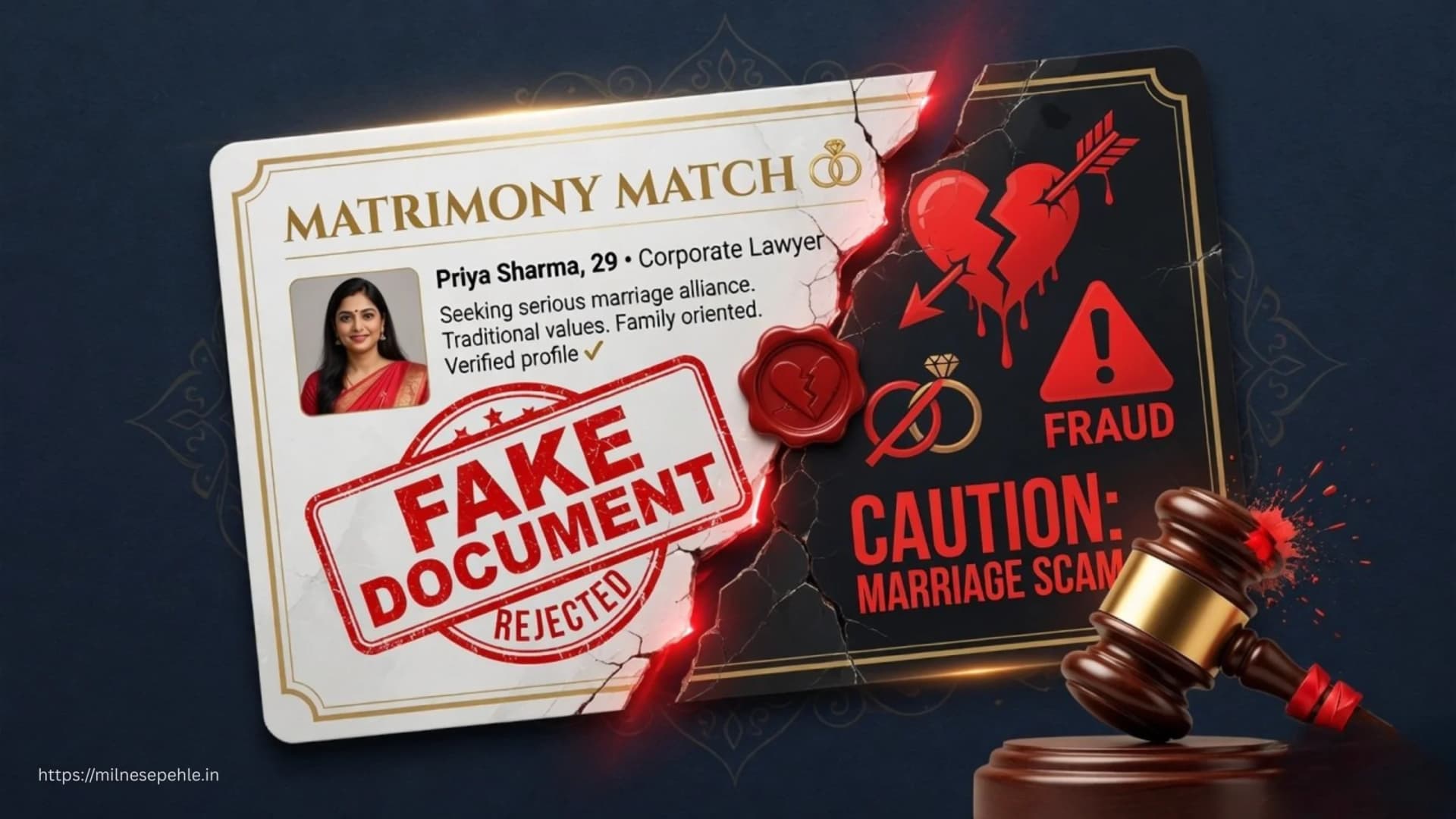
Matrimony fraud in India has reached crisis proportions. Over ₹500 crore is lost to marriage-related scams every year. More than 62,000 cyber fraud cases have been directly linked to matrimony platforms. Behind every statistic is a family whose trust was exploited at the most vulnerable moment of their lives.
The Six Most Common Types of Matrimony Fraud in India
- Financial Misrepresentation: False salary slips, inflated income figures, or fabricated ITR documents. After marriage, the truth emerges through shared accounts and EMI defaults.
- Fake Educational Credentials: Degrees from universities that do not exist, certificates purchased from degree mills. AI now makes convincing fake documents trivially easy.
- Undisclosed Previous Marriages: Some individuals enter matrimony platforms while legally married to someone else, or hide a prior marriage and divorce.
- Hidden Debt and Loans: Active personal loans and credit card defaults that were never disclosed become the couple's shared financial burden after marriage.
- Identity Fraud: Completely fabricated identities, fake names, borrowed photographs, stolen Aadhaar data. 77% of Indians have encountered AI-generated fake profiles.
- The 'Visa Trap' for NRI Families: Fraudsters pose as NRI professionals. Once the marriage happens and the victim reaches a foreign country, they may face abandonment or financial exploitation.
Red Flags That Should Trigger Immediate Verification
The following patterns appear repeatedly in documented cases of matrimony fraud:
- Reluctance to share documents: Any genuine candidate should be comfortable sharing government-verified credentials.
- Inconsistencies in the story: Small contradictions between the profile and conversation often indicate fabrication.
- Pressure to decide quickly: Legitimate families do not rush. Artificial urgency is a manipulation technique.
- Photographs that seem too perfect: Reverse-image search all profile photos.
- Unwillingness to meet in person: Video calls can be faked with deepfake technology.
- No verifiable social media presence: Complete absence of professional footprint can be suspicious.
- Financial requests before marriage: Any request for money before the wedding is a definitive red flag.
Why Matrimony Platforms Cannot Protect You
Matrimony platforms are introduction services. They are not verification services. Their business model depends on maximising the number of profiles, not minimising the number of fraudulent ones.
Most platforms conduct minimal verification, typically just a phone number confirmation. The legal terms of service on virtually every matrimony platform explicitly disclaim responsibility for the accuracy of user-provided information. Families are on their own.
How Marriage Background Verification Stops Fraud Before It Starts
Milne Se Pehle offers a self-verification certificate that covers every dimension where fraud commonly occurs: identity through Aadhaar and PAN, criminal and court records, educational credentials, ITR-verified income history, CIBIL score and active loans, employment history, and previous marriage records.
Crucially, the verification is self-initiated. The candidate gets themselves verified, receives a QR-enabled certificate, and shares it proactively. This is not surveillance, it is transparency. Genuine candidates have every reason to want this. Fraudsters will refuse, and that refusal is itself the answer.
The price starts at ₹9,999 for basic identity and criminal record verification, a fraction of what families spend on the first meeting's catering.
What to Do If You Suspect You Have Already Been Defrauded
If you discover after marriage that your spouse misrepresented themselves materially, you have legal options:
- Section 420 IPC (Cheating): Financial misrepresentation in matrimony with intent to deceive is cognisable under this section.
- Section 494/495 IPC (Bigamy): Marrying while still legally married to another person is a criminal offence in India.
- Hindu Marriage Act, Section 12: Allows annulment of marriage on grounds of fraud.
Ready to get verified?
Start with the Parichay tier at ₹9,999 — identity and criminal record verification in minutes.
Comments
No comments yet. Be the first.