Marriage Background Verification in India: Why 'Hum Unhe Jaante Hain' Is No Longer Enough
A generation ago, every rishta came through someone who vouched for both sides. Today, 60%+ of arranged marriages begin online, the vouching layer is gone. Here is why verification is the modern answer.
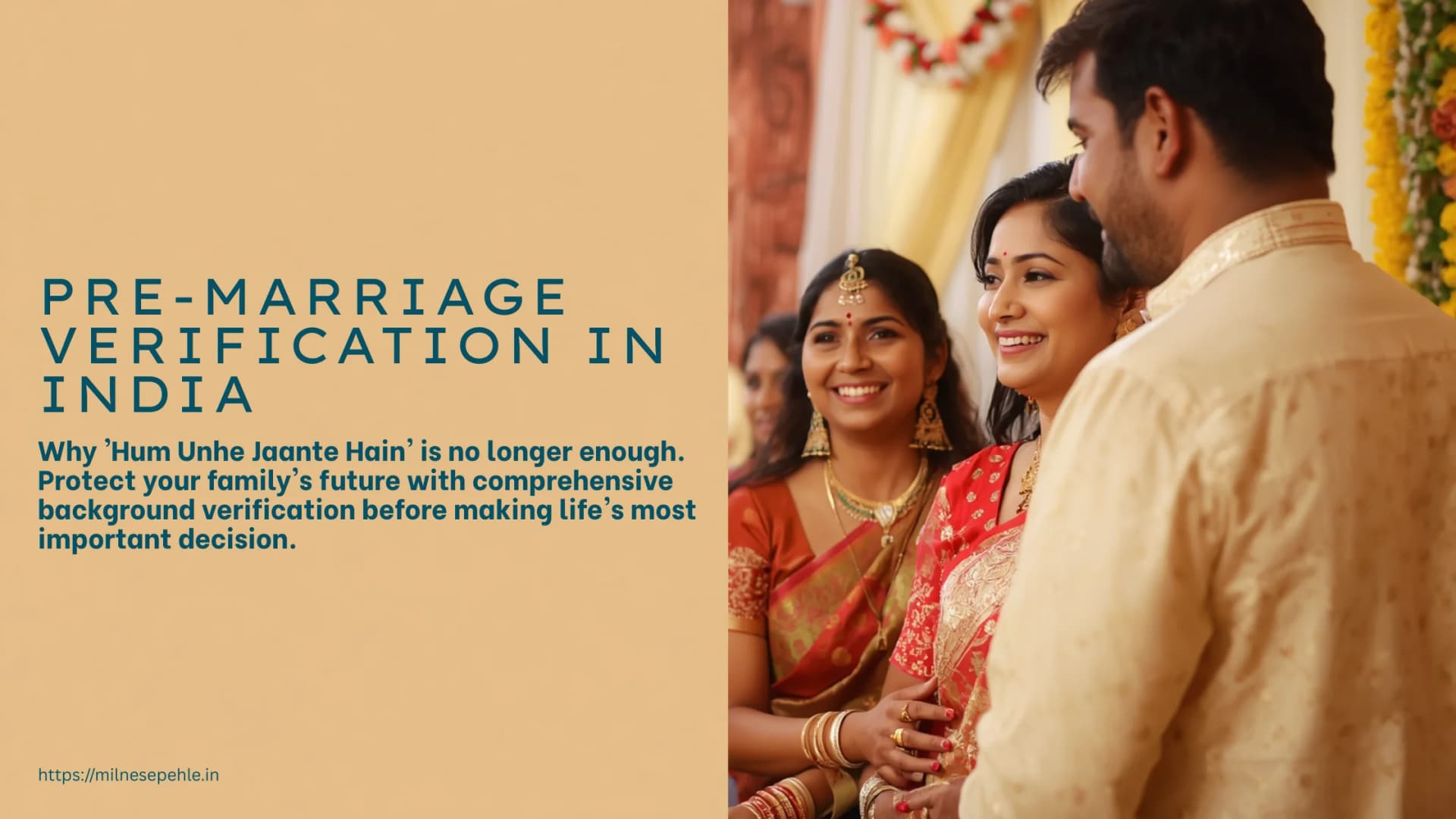
Marriage background verification in India is no longer a paranoid luxury, it is the most practical decision a family can make before one of life's biggest commitments. A generation ago, every rishta came through a pandit, a neighbour, or a family elder who vouched for the other side. Today, over 60% of arranged marriages begin on matrimony platforms where no one knows anyone. The vouching layer that protected Indian families for centuries has quietly disappeared, and nothing has replaced it. Until now.
The Old System Was a Background Check in Disguise
Before online matrimony, families did not need formal verification because community networks served that purpose. When a pandit recommended a match, it meant he knew both families personally. When a neighbour passed along a rishta, it came with an implicit guarantee: 'I know these people. They are who they say they are.'
This informal system worked well for generations. It was not perfect, but it created accountability. The person making the introduction had a reputation at stake.
That system is now broken. Matches today arrive from cities families have never visited, introduced by algorithms rather than elders. The intermediary is a technology platform, and platforms cannot vouch for anyone.
What Can Go Wrong Without Marriage Background Verification
The risks are not hypothetical. India sees over ₹500 crore in matrimony-related fraud losses every year. Over 62,000 cyber fraud cases have been linked to matrimony platforms. The McAfee Modern Love Study found that 77% of Indians have encountered fake AI-generated profiles on matrimony or dating apps.
Beyond outright fraud, there are softer betrayals that cause lifelong damage: undisclosed debts that become a couple's shared burden after marriage, fake salary slips presented to impress prospective families, educational degrees that were purchased rather than earned, and previous marriages that were conveniently forgotten.
The urban divorce rate in India has climbed 30–40% over the past decade. A significant number of divorces trace back to fundamental misrepresentations discovered after the wedding.
What Does Marriage Background Verification Actually Check?
A comprehensive marriage background verification covers several critical areas:
- Identity Verification: Aadhaar and PAN records confirm the person is who they claim to be.
- Criminal and Court Records: A search across criminal databases and court records surfaces any pending cases, FIRs, or convictions.
- Financial Background: Income verification through ITR history, CIBIL score, and active loan checks.
- Employment History: Verifying past employers confirms the professional background.
- Educational Credentials: Degree verification catches fabricated qualifications.
- Previous Marriage Records: One of the most sensitive and most important checks.
- Physical Address Verification: Confirms the family actually lives where they say they do.
The Problem With Hiring a Detective Agency
For decades, detective agencies were the only option for families who wanted verification. Cost: ₹25,000 to ₹90,000 per case, pricing out most middle-class families. Time: two to four weeks. Secrecy: the other party never knows they are being investigated. When they find out, and they often do, trust collapses before the relationship even begins.
The Better Alternative: Self-Verification
Milne Se Pehle (https://MilneSePehle.in) was built around a completely different philosophy. Instead of investigating the other person, you verify yourself, and share that verification willingly.
The concept is simple: get your own background verified against government records and trusted data sources, then receive a QR-verifiable certificate. When a rishta looks promising, you share your certificate. You ask for theirs.
This approach changes the dynamic entirely. You are not conducting surveillance. You are demonstrating transparency. You are saying: 'I have nothing to hide. Here is proof.'
Every tier runs the same full checklist, identity, criminal records, education, income, employment, CIBIL score, active loans, previous marriage, and physical address. What changes as you move up the tiers is how many people are covered under one payment, not what gets checked. Prices start at ₹9,999 for Parichay (1 person) and go up to ₹39,999 for Bandhan (up to 4 people, both families).
Frequently Asked Questions About Marriage Background Verification
- Is marriage background verification legal in India? Yes. Self-initiated background verification using your own consent and government-sourced data is entirely legal.
- How long does verification take? The Parichay tier completes in minutes. Vishwas takes 3–5 business days. Bandhan takes 8–10 days.
- Is the certificate valid forever? Yes. One payment, no renewal required.
- Can I control who sees my certificate? Yes. Access controls stay with the certificate holder. Every view requires an OTP.
The Closing Thought
Indian families spend ₹5 to 30 lakh on a wedding venue, ₹3 to 20 lakh on jewellery, and ₹2 to 10 lakh on catering. The spend on verifying the person they are marrying is typically zero.
Marriage background verification does not mean distrust. It means the opposite: you care enough about this relationship to begin it with complete honesty on both sides.
Ready to get verified?
Start with the Parichay tier at ₹9,999 — identity and criminal record verification in minutes.
Comments
No comments yet. Be the first.