Detective Agency vs Self-Consented Marriage Verification: Which Is Better Before Marriage?
For years, families had two choices before marriage: trust everything or hire a detective. Today there is a third path, one that builds confidence through transparency instead of surveillance.
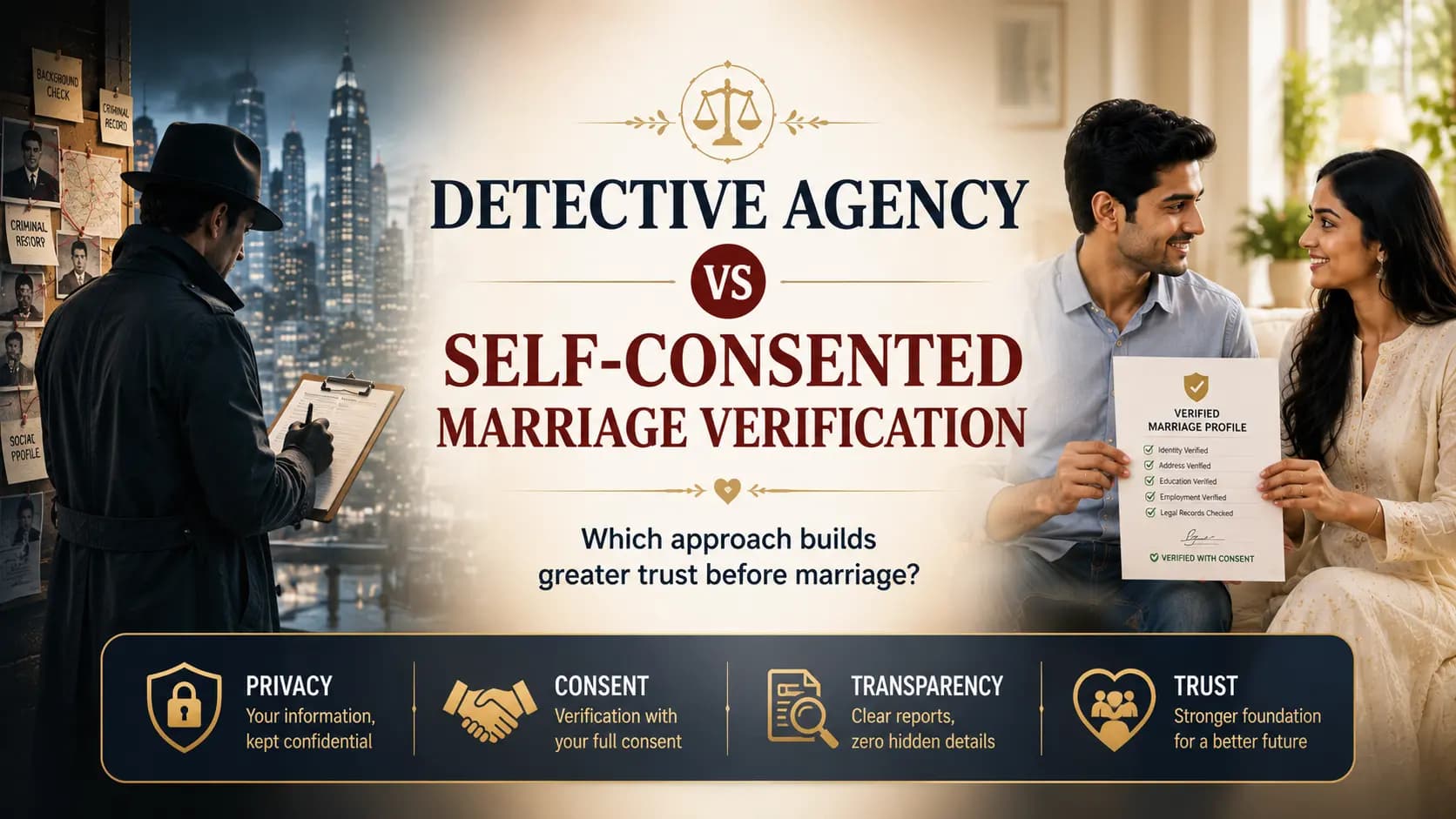
For Years, Families Had Only Two Choices
When parents had doubts before a marriage, they generally had two options.
The first was to trust everything they were told. The second was to hire a detective.
Neither option was ideal. Blind trust can leave important questions unanswered. Secret investigations can create ethical concerns and damage trust if discovered.
Today, there is another approach that is changing how families think about trust before marriage.
It is called Self-Consented Marriage Verification. Instead of secretly investigating someone, both individuals voluntarily verify important information and share it openly with each other.
This simple shift changes the conversation completely: from "How do we secretly find the truth?" to "How can we build trust together?"
Why This Comparison Matters Today
Modern marriages are very different from those of previous generations. People meet through matrimonial platforms, social media, professional networks and dating apps. Families often live hundreds or thousands of kilometres apart.
Traditional community-based trust has become much weaker. As a result, many parents naturally ask how they can know everything important before saying yes.
The answer should strengthen trust rather than weaken it.
What Is a Detective Agency?
A detective agency is a private investigation service that gathers information about an individual, typically without their knowledge.
Depending on the assignment, investigators may collect information relating to employment, lifestyle, family background, daily routine, existing relationships and financial behaviour.
Some rely on publicly available information. Others conduct observations or speak with neighbours, colleagues or local contacts.
What Is Self-Consented Marriage Verification?
Self-Consented Marriage Verification is a transparent process in which an individual voluntarily agrees to verify important aspects of their background and share the results with a prospective partner.
Instead of someone secretly collecting information, the person being verified actively participates. The process may include verification of identity, employment, education, address, professional credentials and publicly available legal records.
The emphasis is on consent, transparency and mutual participation. Both people have the opportunity to demonstrate openness.
The Biggest Difference
The biggest difference is not technology. It is philosophy.
A detective investigation starts with suspicion. Self-consented verification starts with transparency.
One asks, "What might this person be hiding?" The other asks, "How can we openly build confidence?"
That difference shapes the entire relationship.
Side-by-Side Comparison
| Feature | Detective Agency | Self-Consented Verification |
|---|---|---|
| Consent | Usually no | Yes, voluntary and explicit |
| Transparency | Limited | High |
| Relationship impact | May create suspicion if discovered | Encourages openness |
| Privacy | Depends on investigative methods | Information shared voluntarily |
| Participation | One-sided | Mutual |
| Goal | Discover information | Build confidence |
| Long-term trust | May be affected if discovered | Strengthened through openness |
| Communication | Minimal | Encouraged |
Privacy Matters
Privacy is not the opposite of transparency. Healthy transparency is voluntary. Healthy privacy is respected.
Self-consented verification recognises both principles. People choose what they agree to verify. Both parties understand the process. Nothing happens without knowledge or permission.
This creates a far healthier foundation than secret investigations.
Trust Is Built Together
One of the biggest strengths of self-consented verification is reciprocity.
Consider two conversations. In the first: "We hired someone to investigate you." In the second: "We've verified our information and are happy to share it. We'd appreciate the same openness from you."
Which conversation feels more respectful? Which one would make it easier to begin a lifelong relationship?
Why Families Prefer Transparency
Parents rarely enjoy asking uncomfortable questions. They simply want reassurance.
Transparency provides reassurance without turning the relationship into an investigation. When important information is willingly shared, families spend less time worrying about hidden surprises and more time discussing compatibility, values and future plans.
Detective Agencies Still Have a Role
There may be situations where private investigators are appropriate, particularly in legal disputes or cases involving suspected fraud that require specialised investigation.
However, most marriages do not begin because one person is under serious suspicion. Most begin because two families want confidence.
Confidence and investigation are not always the same thing. Where openness is possible, transparency often achieves the goal more constructively.
Self-Verification Encourages Honest Conversations
Verification should never replace communication. Instead, it should support it.
When people voluntarily verify information, they also become more comfortable discussing career plans, financial goals, family responsibilities, previous life experiences and expectations after marriage.
Verification confirms facts. Conversation builds understanding. Both are important.
Building a Culture of Trust
Imagine if showing verified information before marriage became as normal as exchanging family introductions.
Families would spend less energy trying to uncover hidden information. Instead, they could focus on whether two people are genuinely compatible.
That is a healthier direction for modern relationships.
Which Approach Is Better?
There is no universal answer for every family. Every situation is different.
However, for relationships built on mutual respect, transparency generally offers several advantages: it encourages honesty, respects consent, protects dignity and builds confidence without relying on secrecy.
These qualities are closely aligned with the kind of trust that successful marriages require.
The Future of Marriage Verification
As digital matchmaking continues to grow, trust will become even more important.
The future is unlikely to be defined by choosing between blind faith and private investigations. Instead, it will be shaped by responsible verification, mutual consent and transparent communication.
Technology can verify facts. Only openness can build lasting trust.
Final Thoughts
Marriage is not only about finding the right person. It is also about creating the right foundation.
For many years, families believed their only options were complete trust or secret investigation. Today, there is another path.
A path where honesty is shared rather than extracted. A path where verification supports relationships instead of testing them. A path where trust begins before the wedding, not after it.
Self-consented marriage verification is more than a process. It represents a different way of thinking about trust.
And in a world where people increasingly meet online and across cities, that shift may become one of the most important changes in modern marriage.
What is self-consented marriage verification?
Self-consented marriage verification is a process where an individual voluntarily agrees to verify specific information, such as identity, education or employment, and shares the verified results with a prospective partner. The emphasis is on mutual transparency and informed decision-making.
How is self-consented verification different from hiring a detective?
A detective investigation is typically conducted without the subject's knowledge, while self-consented verification is voluntary and transparent. One focuses on gathering information discreetly, whereas the other focuses on building trust through openness.
Is self-consented verification legally safer?
Because the process is based on the individual's knowledge and consent, it generally avoids many of the privacy concerns associated with secret investigations. However, all verification should comply with applicable laws and data protection requirements.
Can verification replace trust?
No. Verification can confirm specific facts, but trust ultimately grows through communication, shared values and consistent behaviour. Verification is best viewed as one tool that supports informed decision-making rather than replacing relationships.
Should both people verify themselves?
Where appropriate, mutual participation creates a balanced process. When both individuals voluntarily share verified information, it reinforces equality, transparency and respect.
Ready to get verified?
Start with the Parichay tier at ₹9,999 — identity and criminal record verification in minutes.
Comments
No comments yet. Be the first.