Why Someone Wants to Rush Your Marriage: 9 Reasons to Slow Down and Verify
A rushed marriage proposal doesn't automatically mean something is wrong, but it can mean there isn't enough time to ask questions. Here are 9 situations where slowing down and verifying important facts is worth it.
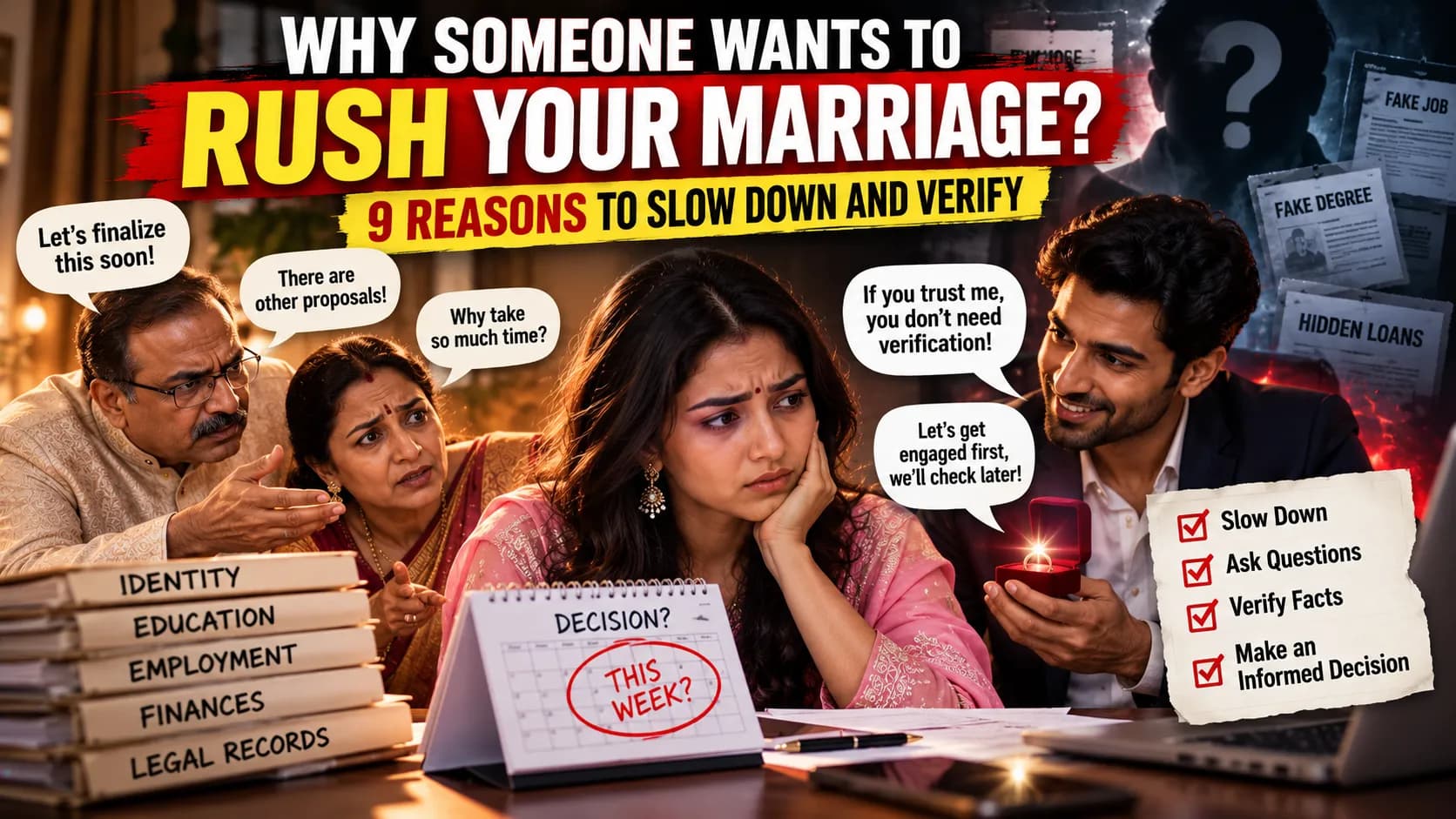
The proposal looks good. The families have met. Everyone likes each other. The job is impressive. The photographs look genuine. The conversations are going well.
Then suddenly, the timeline changes.
"We should finalize this soon." "There are other proposals coming in." "Why do we need so much time?" "Let's get engaged first and figure everything out later." "If you trust me, why do you need verification?"
Sometimes there is a perfectly reasonable explanation for wanting to move quickly. A family may have genuine personal circumstances. Two people may simply feel confident about each other. Cultural or family considerations may also influence the timeline.
Rushing a marriage is not, by itself, proof that someone is hiding something.
But when a major life decision is being pushed forward before important questions can be answered, it is reasonable to slow down.
Marriage can involve finances, legal responsibilities, family relationships, relocation, career decisions and long-term commitments.
You don't need to assume the worst. You simply need enough time to make a decision with relevant information.
Here are nine situations where slowing down and verifying important facts may be worth considering.
1. They Want a Decision Before You Have Enough Information
One of the simplest warning signs is not the speed itself. It is the pressure to decide before reasonable questions have been answered.
For example: "Everything is good. Why do you need to check anything?" "Our families already know each other." "Just trust us." "We need an answer this week."
The question is not whether the deadline is legitimate. The question is whether you have enough information to make the decision they are asking you to make.
If you don't know basic facts about someone's identity, education, employment, finances or marital history, there is nothing unreasonable about asking for time to understand them.
2. "If You Trust Me, You Don't Need Verification"
This sentence can sound emotional because trust is an important part of any relationship. But trust and verification are not opposites. You can trust someone while still confirming important information.
If someone says "I have a degree from this university," you can believe them and still verify the qualification. If someone says "I work for this company," you can trust the statement and still confirm the employment claim where appropriate. If someone says "I've never been married," you can accept the conversation while still treating marital history as an important fact that deserves clarity.
A useful principle: verification is about facts, trust is about relationships. They do different jobs.
3. Important Documents Are Always "Coming Later"
Another situation worth paying attention to is repeated postponement. You ask for information, and the response is "I'll share it later." Then later becomes "Let's wait until the families meet." Then "We'll do it after engagement." Then "Why are you asking for so many documents?"
There can be legitimate reasons for not immediately sharing sensitive information. Privacy should be respected. But if a particular piece of information is important to your decision, repeatedly postponing it should be discussed openly.
Don't accuse. Ask: "What information are we comfortable verifying before we proceed?" That keeps the conversation focused on transparency rather than suspicion.
4. The Story Keeps Changing
People can remember details differently. Dates can be mistaken. Job titles can change. People move cities. Names can have different spellings. Not every inconsistency is meaningful.
But repeated contradictions across important parts of someone's story deserve clarification. For example, a first conversation might mention "I completed my MBA in 2019," a later conversation says "I graduated in 2021," and the biodata says "MBA - 2018."
One difference may be a mistake. Several unexplained differences across important information may justify asking for supporting information.
The right response is not "You're lying." It is "Can you help me understand which information is correct?" Verification should help answer that question.
5. There Is Pressure to Stop Asking Questions
A marriage proposal should allow reasonable questions from both sides. But sometimes questions are treated as an insult. You may hear "Why are you interrogating me?", "Our family has never been asked this before," "Do you think we're criminals?" or "If you have doubts, don't proceed."
Again, there may be genuine emotional reasons behind these reactions. Nobody likes feeling distrusted. But asking reasonable questions about a major life decision is not automatically disrespectful.
A healthier approach is mutual transparency. Instead of "I want to investigate you," try "Let's both verify the important information so neither family has unanswered questions."
6. They Want Money or Major Commitments Before Verification Is Complete
This deserves particular attention. Be cautious about making significant financial commitments while important information about a prospective marriage remains unresolved.
Examples could include pressure to:
- Pay large amounts
- Book expensive arrangements immediately
- Transfer money
- Make joint purchases
- Invest in a business
- Take loans
- Commit to major relocation expenses
- Enter financial agreements
The exact circumstances matter. There may be legitimate reasons for wedding-related expenses. But if someone is asking you to make substantial financial commitments while simultaneously discouraging reasonable questions, slowing down can be sensible.
Before making a major financial commitment, ask: what do we know, what remains unclear, and what should be verified first?
7. Their Personal or Professional Story Seems Too Perfect
A perfect profile can be appealing. Perhaps the person has:
- An excellent education
- A prestigious job
- A high income
- A successful business
- A respected family
- An impressive social profile
- A seemingly flawless background
There is nothing wrong with any of these things. But the more important the claim is to your decision, the more useful it can be to establish whether the information is accurate.
A matrimonial biodata is a presentation. It is not automatically an independently verified record. Impressive is not the same as verified.
8. You Are Being Told to Ignore a Specific Red Flag
Sometimes the pressure is not to rush the entire marriage. It is to ignore one particular issue. For example: "Don't worry about his previous job." "Her degree isn't important." "The loan is a family matter." "The previous marriage doesn't need to be discussed." "The legal issue is old." "Don't ask too many questions about their family."
Each statement could have a perfectly legitimate explanation. But the important question is why this particular piece of information is being discouraged from discussion. The answer may be harmless, or it may reveal something important. You won't know without asking.
9. They Want Commitment Before You Have Met Properly
Online matrimonial platforms have made it possible for people to communicate extensively without spending much time together in person. Long conversations, video calls and social media can all create familiarity. But familiarity is not necessarily the same as knowing someone comprehensively.
Before making a major commitment, consider whether you have had enough opportunity to understand:
- Their personality
- Their expectations
- Their family circumstances
- Their career plans
- Their financial expectations
- Their views on children
- Their location preferences
- Their responsibilities
- Their values
- Important aspects of their past
Verification does not replace these conversations. It complements them.
Why Do People Rush Marriage?
Not every rushed marriage proposal has a hidden motive. There are many legitimate reasons families or individuals may want to move quickly. These can include:
- Family circumstances
- Age-related considerations
- Relocation plans
- Work commitments
- Personal preferences
- Cultural expectations
- Existing family arrangements
- A strong mutual decision between two adults
This is why speed alone should never be treated as evidence of fraud. The relevant issue is whether the pressure prevents reasonable questions from being answered.
The Real Red Flag May Be the Lack of Time to Verify
Consider two situations.
In the first, someone says: "We would like to move quickly because of our family circumstances. But please take whatever reasonable time you need to ask questions and verify the information."
In the second: "You have three days to decide. Don't ask questions. Don't verify anything. Just trust us."
The difference isn't simply the timeline. It is the attitude toward transparency. Healthy urgency can still allow informed decision-making. Unhealthy pressure can make informed decision-making difficult.
What Should You Verify Before Agreeing to Marriage?
If you feel that the timeline is moving too quickly, create a simple verification checklist:
- Identity - confirm important identity information and whether relevant documents are consistent.
- Education - verify qualifications that are materially relevant to the person's profile.
- Employment - establish whether important employment claims are accurate.
- Income - understand the financial picture rather than relying only on a stated salary.
- Financial liabilities - discuss significant loans, obligations and responsibilities.
- Legal history - where relevant and lawfully available, understand applicable court or legal records.
- Previous marriage - clarify whether either person has been married previously and, where applicable, whether the previous marriage has legally ended.
- Address - establish current and relevant residential information.
- Family responsibilities - discuss major responsibilities that could materially affect married life.
Don't Turn Every Discrepancy Into an Accusation
This is extremely important.
Suppose a person's biodata lists their address as Delhi, but their current employment is in Bengaluru. That is not suspicious by itself - they may simply work in Bengaluru.
Suppose their degree certificate has a slightly different spelling of their name. That doesn't necessarily mean the document is fake.
Suppose their employment dates are different by several months. There may be an innocent explanation.
Verification should follow this process: notice, ask, understand, verify, decide. Not: notice, assume, accuse. That distinction makes the process fairer and more useful.
What If They Say, "We Don't Have Time"?
Then ask yourself: what exactly is preventing us from taking reasonable time to verify important facts?
A wedding date can be changed. An engagement can be postponed. A decision can be delayed. But once significant commitments have been made, reversing them can become substantially more complicated.
There is nothing wrong with saying: "I am interested in this relationship, but I need reasonable time to understand and verify the important information before making a lifelong commitment." That is a reasonable boundary.
What If Both Families Are Applying Pressure?
This can be particularly difficult in arranged marriage situations. You may hear "Everyone likes the match," "Why are you creating doubts?", "The other family may move on," "This is a very good proposal," or "We don't want to lose this opportunity."
But the decision ultimately concerns the people who will enter the marriage. Family opinions can be valuable. Family pressure should not replace informed consent.
A simple response can be: "We're not saying no. We're saying we want enough time to understand the important facts before saying yes."
What If the Person Says, "I Have Nothing to Hide"?
That sounds reassuring. But the best way to establish transparency is not simply through a statement. It is through a process.
If both people genuinely want transparency, they can agree on reasonable categories of information to verify: you verify me, I verify you, we use the same standard, we respect each other's privacy, and we discuss discrepancies before drawing conclusions.
That creates a much healthier framework than secretly investigating one another.
Mutual Verification Can Change the Conversation
Instead of "Why are you checking me?", the conversation becomes "Let's both check the important things."
That is particularly useful for modern marriages where both partners may have:
- Careers
- Financial commitments
- Education
- Previous relationships
- Family responsibilities
- Digital identities
- Independent financial lives
Transparency should not be a one-way demand. It should ideally be reciprocal.
Is Marriage Verification About Distrust?
No. Consider other major decisions. Before buying a house, people verify documents. Before investing money, people examine financial information. Before joining a company, candidates research the organisation. Before signing an agreement, people read the terms.
Marriage is a personal relationship, but it can also involve significant practical commitments.
Verification does not answer whether you will love this person. It helps answer whether the important factual claims you are relying on are accurate. Those are two different questions.
What You Should Never Do During Verification
Being concerned about a marriage proposal does not give anyone the right to invade another person's privacy. Do not:
- Hack someone's account
- Access private emails
- Obtain passwords
- Impersonate the person
- Secretly access private messages
- Purchase unlawfully obtained personal data
- Install spyware
- Pretend to be someone else to obtain confidential information
- Spread unverified allegations
Verification should be conducted through legitimate, lawful and appropriate methods. The goal is information, not intrusion.
What If Verification Finds Something?
Don't immediately decide what it means. First ask what exactly was found. Then whether the information is accurate. Then what the legal or factual status is. Then whether the person has provided an explanation. And finally, how important the information is to your decision.
For example, discovering a previous job change is very different from discovering that someone concealed a previous marriage. The significance of information depends on the circumstances.
The 24-Hour Rule for Major Decisions
If someone is putting intense pressure on you to make an immediate decision, consider creating your own pause.
You can say: "I don't want to make a lifelong decision under pressure. I need time to think, ask questions and verify the important information."
You don't need to justify every question. You don't need to accuse anyone. You simply need enough space to make your own informed decision.
A Better Marriage Timeline
Instead of proposal, pressure, engagement, verification, consider: proposal, conversation, questions, verification, discussion, decision, commitment.
This doesn't mean every relationship needs a long process. It means important information should not be postponed until after major commitments have already been made.
15 Questions to Ask Before Saying Yes
If a marriage proposal is moving quickly, these questions can help slow the process down constructively:
- What is your current employment?
- What is your actual educational background?
- Where do you currently live?
- What are your long-term career plans?
- What are your financial expectations?
- Do you have significant loans or financial obligations?
- Have you been married before?
- Are there any ongoing matrimonial proceedings?
- Are there important family responsibilities we should discuss?
- Where do you expect to live after marriage?
- What are your expectations regarding children?
- How will major financial decisions be handled?
- What level of financial independence do you expect?
- Is there anything important about your past that I should know?
- Are you comfortable with both of us verifying important information before marriage?
The objective isn't to interrogate someone. It is to have the conversations that matter.
When Should You Consider Background Verification?
There is no single universal point in every relationship. But verification can be particularly relevant before:
- Engagement
- Finalizing the wedding
- Paying substantial wedding expenses
- Making relocation decisions
- Combining finances
- Purchasing property together
- Making other major commitments
The principle is simple: verify before the commitment becomes harder to reverse.
What Milne Se Pehle Offers
Milne Se Pehle is a consent-based marriage verification platform designed to help people and families verify important matrimonial information before marriage.
Depending on the verification scope, checks can cover areas such as:
- Identity
- Education
- Employment
- Income
- Financial information
- Address
- Legal and court records
- Other relevant background information
The approach is different from secretly investigating a prospective partner. The idea is simple: you verify yourself, they verify themselves, and both sides get greater transparency before marriage. That makes the process less about suspicion and more about informed decision-making.
If Someone Is Rushing You, Don't Panic. Slow Down.
A rushed marriage proposal doesn't automatically mean something is wrong. But you are allowed to ask questions. You are allowed to request time. You are allowed to verify important facts. You are allowed to discuss finances. You are allowed to understand someone's past.
You are allowed to say: "I need more information before I make this decision." And if someone genuinely respects your decision, they should be able to understand why.
Frequently Asked Questions
Why would someone rush a marriage?
There can be many legitimate reasons, including family circumstances, personal preferences, relocation, cultural expectations or simply feeling confident about the relationship. Rushing alone does not prove that someone has bad intentions. The concern arises when pressure prevents reasonable questions or verification.
Is rushing marriage a red flag?
Rushing marriage is not automatically a red flag. However, pressure to make a major decision before important information can be discussed or verified may be a reason to slow down and ask more questions.
What should I verify before marriage?
Important areas may include identity, education, employment, income, financial liabilities, relevant legal records, previous marriage history, address and significant family responsibilities.
Should I verify someone if I trust them?
Trust and verification serve different purposes. You can trust someone while confirming important factual claims, particularly when those facts could materially affect a major life decision.
What if my partner gets offended when I ask for verification?
Explain that the process is intended to be mutual and transparent. Both people can agree on reasonable categories of information to verify and use the same standard for each other.
Should both bride and groom be verified?
A reciprocal process can create greater transparency. Both people can voluntarily agree to verify relevant information about themselves.
Is refusing verification proof that someone is hiding something?
No. Someone may have legitimate privacy concerns or may disagree with the scope of verification. Refusal should not automatically be treated as proof of fraud.
How long should I take before agreeing to marriage?
There is no universal timeline. The appropriate amount of time depends on the relationship and circumstances. The important principle is that you should have enough time to understand the person, discuss major expectations and verify important factual claims before making significant commitments.
Can marriage verification guarantee that someone is trustworthy?
No. Verification cannot predict someone's future behaviour, personality or compatibility. It can only help establish certain factual information.
Can I verify someone before marriage without secretly spying on them?
Yes. Legitimate, consent-based verification can be used to establish relevant information without hacking, impersonation, unauthorized access or intrusive surveillance.
Final Thought
The right person should not need you to make a lifelong decision without enough information. That doesn't mean they must agree to every request for information. It means both people should be able to have a reasonable conversation about what matters.
Because the question isn't "Why are you taking so long?" The better question is "Do we know enough to say yes?"
Before the engagement. Before the wedding. Before the financial commitments. Before the families become deeply involved.
Slow down. Ask questions. Verify what matters. Then decide. Know the facts before you say yes.
Ready to get verified?
Start with the Parichay tier at ₹9,999 — identity and criminal record verification in minutes.
Comments
No comments yet. Be the first.