Too Late After Marriage: 10 Things Families Wish They Had Verified Before Saying Yes
Sometimes the biggest problem isn't what a family discovers about a prospective match - it's when they discover it. Here are 10 things worth verifying before saying yes, not after the wedding.
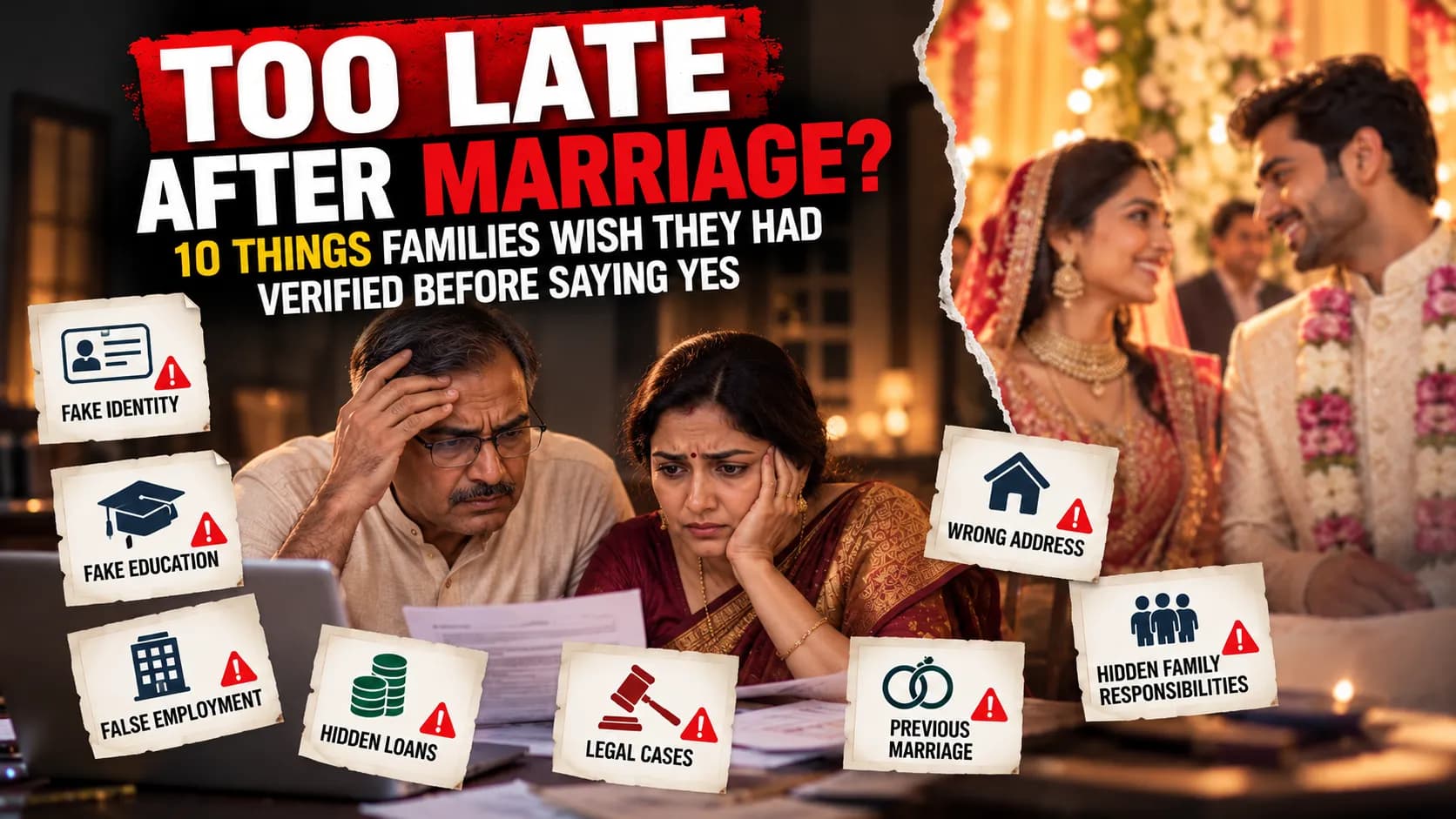
The wedding is over. The photographs are framed. The families have celebrated. The couple has started building a life together.
And then, slowly, an uncomfortable truth comes out.
A previous marriage was never mentioned. The job wasn't what it was presented as. There are financial obligations nobody knew about. A qualification on the biodata doesn't match reality. A legal issue was never disclosed. An important part of the person's past was deliberately left unexplained.
At that point, the question is no longer "Should we verify this before marriage?" It becomes "Why didn't we verify this earlier?"
Marriage is not simply an emotional decision. It can also involve finances, legal responsibilities, family commitments, relocation, career decisions and long-term planning.
That is why reasonable due diligence before marriage can help both individuals and families make informed decisions.
This doesn't mean assuming that everyone is hiding something. It means understanding an important difference: trust is important in a marriage, but verification helps make sure important facts are not based only on assumptions.
Here are 10 areas worth considering before saying yes.
1. Identity
One of the most basic things to establish before marriage is whether the person's core identity information is accurate and consistent. This can include:
- Full legal name
- Date of birth
- Identity documentation
- Address information
- Name variations
- Consistency across relevant documents
Why does this matter? Because every other verification depends on knowing that the information belongs to the correct person.
A name variation does not automatically mean something is wrong. Differences can happen because of spelling, transliteration, documentation practices or legitimate name changes. The purpose of identity verification is not to create suspicion - it is to establish the facts.
Ask yourself: do we know who this person is on paper, or are we relying entirely on what was told to us?
2. Educational Qualifications
Education is commonly included in matrimonial profiles. A biodata might mention an MBA from a reputed institution, an engineering degree from a particular university, or a master's degree from a foreign university. These claims can influence how families understand someone's professional background. But a qualification written on a profile is still a claim until it is appropriately verified.
Depending on the situation, relevant checks may include:
- Institution
- Degree
- Course
- Graduation year
- Qualification status
- Whether the qualification can be confirmed through an appropriate source
A person does not need a prestigious degree to be a good life partner. The issue is not prestige. The issue is accuracy.
3. Employment and Job History
A person's employment can affect expectations around income, location, lifestyle and future plans. Before marriage, families may want to understand whether claims about:
- Current employer
- Designation
- Employment duration
- Previous employment
- Professional experience
- Work location
are accurate. Imagine someone says they have been working with a company for six years, but later information suggests a substantially different employment history. That does not automatically establish deception - there could be a legitimate explanation. But it creates a question that is better answered before marriage than after it.
A discrepancy is a reason to ask questions. It is not automatically proof of fraud.
4. Income and Financial Position
Money can be uncomfortable to discuss. That discomfort is exactly why financial transparency can become important before marriage. Someone may disclose their salary, but salary alone does not necessarily tell you their complete financial situation.
Relevant financial considerations may include:
- Income
- Existing loans
- EMIs
- Credit obligations
- Business liabilities
- Financial dependants
- Major ongoing commitments
- Significant financial responsibilities
A person earning a high salary may also have substantial monthly obligations. Another person with a lower salary may have very limited debt. Neither situation automatically makes someone suitable or unsuitable for marriage, but both people should have a realistic understanding of the financial situation they are entering.
The question isn't whether a person has debt. The better question is whether important financial obligations are being honestly disclosed and understood.
5. Previous Marriage or Marital Status
This is one of the facts that can have major legal and personal consequences. A previous marriage is not inherently a problem - many divorced or previously married people go on to have successful marriages. The issue arises when material information about marital history is deliberately concealed.
Depending on the circumstances, relevant questions may include:
- Has the person been married before?
- If yes, when?
- Has the previous marriage legally ended?
- Is there a divorce decree?
- Are there ongoing matrimonial proceedings?
- Are there unresolved legal obligations?
Finding out about a previous marriage after the wedding can create an entirely different situation from learning about it before making the decision.
Transparency matters more than perfection. Everyone has a past. The important question is whether both people understand that past before making a major commitment.
6. Relevant Legal or Court History
Legal history can be one of the most sensitive areas of matrimonial verification. Families may be concerned about matters such as:
- Pending cases
- Relevant court proceedings
- Criminal proceedings
- Matrimonial litigation
- Other publicly verifiable legal records
But this area requires particular care. A complaint is not the same as a conviction. An FIR is not the same as a finding of guilt. A pending case is not proof that a person committed an offence. A responsible verification process should distinguish between different legal statuses and present information accurately.
The goal is not to label someone. The goal is to make sure that potentially important legal information is not discovered accidentally after marriage.
7. Address and Residential Information
Where someone lives can seem like a simple detail, but address information can sometimes reveal inconsistencies in a matrimonial profile. Families may want to understand:
- Current residence
- Permanent address
- Previous relevant addresses
- Work location
- Whether the information provided is consistent
There may be perfectly legitimate explanations for differences. Someone may work in another city, rent a home, maintain a family home elsewhere, have recently relocated, or travel frequently for work. An address discrepancy should not automatically be treated as suspicious - the purpose of verification is to understand the reality behind the information.
8. Family Information That Materially Affects the Marriage
Marriage often involves two individuals, but family circumstances can also influence the future relationship. Important information may include circumstances relating to:
- Dependants
- Major family responsibilities
- Existing obligations
- Significant financial responsibilities
- Relevant family circumstances that materially affect the couple
This does not mean demanding every private detail about someone's family. Privacy matters. The focus should be on information that could reasonably affect major decisions within the marriage.
A useful question, for both sides, is whether there is anything about their family circumstances that the other person reasonably needs to know before making this decision.
9. Professional and Social Claims
Matrimonial profiles often contain more than education and employment. People may describe themselves as:
- Business owners
- Entrepreneurs
- Investors
- Doctors
- Lawyers
- Government employees
- Senior executives
- Professionals with specific licenses or credentials
Where such claims are important to the marriage decision, appropriate verification can help establish whether the claim is accurate. The objective is not to judge someone's profession - a person doesn't need an impressive title to have a meaningful marriage. But deliberately presenting a substantially different professional identity can affect informed consent.
10. The Information That Was Never Mentioned
This may be the most important category of all. Sometimes the biggest concern isn't an incorrect answer, it is a missing answer. Things such as:
- Previous marriage
- Major financial liabilities
- Significant legal proceedings
- Major career changes
- Important family responsibilities
- Material differences between the biodata and reality
may never be discussed. This is why verification should not simply ask whether the information provided is true. It should also ask whether there are important facts that should reasonably have been disclosed. That distinction matters.
Why Do Families Discover These Things So Late?
There are several reasons.
1. Everyone Wants to Believe the Best
When a proposal looks promising, people naturally focus on positive information: a good job, a good family, a good education, a good personality. Once everyone becomes emotionally invested, questioning information can feel uncomfortable.
2. Families Confuse Familiarity With Verification
Meeting someone's parents is useful. Talking to their friends can be useful. Visiting their home can be useful. But none of these necessarily verifies every factual claim. A person can be socially well known while still having information on their biodata that has never been independently established.
3. Nobody Wants to Appear Suspicious
One of the biggest barriers to marriage verification is social pressure. Someone may think, "If I ask for documents, they'll think I don't trust them," or "What if their family gets offended?"
This is exactly why verification should ideally be mutual. Instead of "I want to investigate you," the conversation can become "Let's both verify the important things before we make such a big decision." That is a very different approach.
Verification Should Not Mean Spying
There is a major difference between responsible verification and invasive investigation.
Responsible verification should respect:
- Consent
- Privacy
- Applicable laws
- Data protection principles
- The individual's reasonable expectations of privacy
It should not involve:
- Hacking
- Accessing private accounts without permission
- Impersonation
- Obtaining confidential information unlawfully
- Secretly accessing someone's private communications
- Unlawful surveillance
The purpose is to establish relevant facts, not to invade someone's entire personal life.
What Should Both People Verify?
Verification does not have to be one-sided. A healthier approach can be for one person to verify the other, and for that person to verify them back. That creates a shared standard, where both sides agree in advance on what information is relevant.
| Verification Area | Person A | Person B |
|---|---|---|
| Identity | Yes | Yes |
| Education | Yes | Yes |
| Employment | Yes | Yes |
| Income | Yes | Yes |
| Financial obligations | Yes | Yes |
| Relevant legal records | Yes | Yes |
| Previous marriage | Yes | Yes |
| Address | Yes | Yes |
The exact scope should depend on the circumstances and what both individuals reasonably agree to verify.
What If Everything Comes Back Clean?
That is not a guarantee of a perfect marriage.
Verification cannot tell you:
- Whether two people will communicate well
- Whether their personalities are compatible
- Whether they will handle disagreements maturely
- Whether they will share the same values
- Whether their marriage will be successful
Those questions require conversation, time and personal judgment. Verification answers a different question: are important factual claims consistent with the information that can legitimately be verified? That is valuable in itself.
What If You Find an Inconsistency?
Don't immediately jump to a conclusion. Follow a simple process:
- Identify the discrepancy - what exactly does not match?
- Ask for an explanation - give the person an opportunity to explain.
- Check the supporting information - where appropriate, verify the explanation.
- Understand the significance - is it a harmless documentation difference, or a material fact that could affect the marriage decision?
- Make your own decision - verification gives you information, it does not make the decision for you.
The Cost of Finding Out Too Late
The biggest reason to verify before marriage is not fear. It is timing.
Before marriage, discovering an inconsistency gives both people an opportunity to:
- Ask questions
- Clarify facts
- Discuss expectations
- Seek legal advice where appropriate
- Reconsider commitments
- Continue the relationship with better information
After marriage, the same issue may involve:
- Emotional distress
- Financial complications
- Family conflict
- Legal proceedings
- Separation
- Additional responsibilities
That does not mean every problem discovered after marriage could have been prevented through verification. It simply means that some important facts are easier to discuss before a major commitment than after it.
A Simple Pre-Marriage Verification Checklist
Before finalizing a marriage, consider asking:
- Identity - is the person's identity information consistent, and are important documents authentic and relevant?
- Education - are important qualifications accurate, and does the stated educational history match available evidence?
- Employment - is the current employer accurately represented, and does the professional history make sense?
- Finances - are income expectations realistic, and are significant loans or financial obligations disclosed?
- Legal - are there relevant legal proceedings that should be known, and is their actual status clearly understood?
- Marriage history - has either person been married previously, and if yes, has the previous marriage legally ended?
- Address - is the current residential information accurate, and are significant discrepancies explained?
- Family responsibilities - are there major responsibilities that could materially affect married life?
- Transparency - are both people comfortable answering reasonable questions?
- Consent - are both parties comfortable with the verification process?
Before You Say "Yes", Ask These Five Questions
If you remember nothing else from this article, remember these:
- What do I know for certain?
- What am I simply assuming?
- Which claims can reasonably be verified?
- Have both sides been equally transparent?
- Am I making this decision with complete information available to me?
These questions don't make marriage less romantic. They make the decision more informed.
Marriage Verification Is About Transparency, Not Suspicion
There is nothing wrong with trusting someone. There is also nothing wrong with wanting important facts to be accurate. Both can exist together.
You can genuinely like someone and still verify their qualifications. You can respect someone's family and still ask reasonable questions. You can trust your partner and still discuss finances. You can believe someone's story and still confirm important documents.
Verification is not automatically an accusation. When done transparently and with consent, it can simply be another way of making an important life decision with better information.
How Milne Se Pehle Approaches Marriage Verification
Milne Se Pehle is built around the idea of consent-based marriage verification. Instead of treating verification as secretly investigating a prospective bride or groom, the approach encourages transparency between both sides.
Depending on the verification package and applicable checks, relevant areas can include:
- Identity
- Education
- Employment
- Income
- Financial information
- Address
- Legal and court records
- Other relevant background information
The principle is simple: before you trust someone with your future, know the important facts about the person you're trusting. And ideally, both sides should be willing to follow the same standard.
Frequently Asked Questions
What are the most important things to verify before marriage?
Important areas can include identity, education, employment, income, financial obligations, relevant legal records, previous marriage history and address. The appropriate checks depend on the circumstances and should be conducted lawfully.
Is marriage verification necessary in India?
There is no universal legal requirement that every person must undergo a background verification before marriage. However, individuals and families may choose to conduct reasonable due diligence before making a major personal commitment.
What should I check about a prospective groom before marriage?
Depending on the circumstances, you may consider verifying identity, education, employment, income, financial obligations, relevant legal records, marital history and address. The same principle should apply when evaluating a prospective bride.
Can I verify someone's previous marriage?
The availability and legality of information depend on the specific circumstances and applicable records. Where previous marital status is important, the person should be asked directly and relevant documentation or lawful verification methods can be considered.
Should both bride and groom be verified?
A reciprocal verification process can create greater transparency. Both individuals can agree on the information that is relevant and appropriate to verify.
Is background verification before marriage an insult?
Not necessarily. Verification can be presented as a mutual process rather than an accusation. Both sides can agree to verify the same categories of information before making a major commitment.
What if I discover a discrepancy during verification?
First, understand exactly what the discrepancy is. Ask the person for an explanation and consider supporting documentation or additional verification where appropriate. A discrepancy does not automatically prove fraud.
Does a criminal case mean someone is guilty?
No. A complaint, FIR, pending case, acquittal and conviction have different legal meanings. Any legal-record verification should accurately represent the status of the matter.
Can marriage verification guarantee a successful marriage?
No. Verification can help establish certain factual information, but it cannot predict compatibility, personality, communication or the future success of a relationship.
When should I verify someone before marriage?
Verification can be considered before major commitments such as engagement, wedding arrangements or significant financial decisions. The goal is to understand important facts before making an irreversible or difficult-to-reverse commitment.
Final Thought
Nobody enters a marriage expecting to discover something devastating later. Most families believe the person in front of them is genuine. And sometimes they are.
But a marriage decision can involve decades of shared finances, responsibilities, family relationships and legal commitments.
So before asking whether you like this person, also ask whether you know the important facts about this person.
Because there are things you can discuss before marriage. There are things you can verify before marriage. And there are things that become much harder to deal with once the marriage has already happened.
Don't wait for a wedding to reveal what a reasonable verification could have helped you understand beforehand. Know the facts before you say yes.
Ready to get verified?
Start with the Parichay tier at ₹9,999 — identity and criminal record verification in minutes.
Comments
No comments yet. Be the first.