Everything Looked Perfect Before Marriage - Until They Checked These 7 Things
A perfect biodata and a good conversation are not the same as verified facts. Here are seven things Indian families should check - identity, education, employment, finances, legal records, marital history and address - before saying yes to marriage.
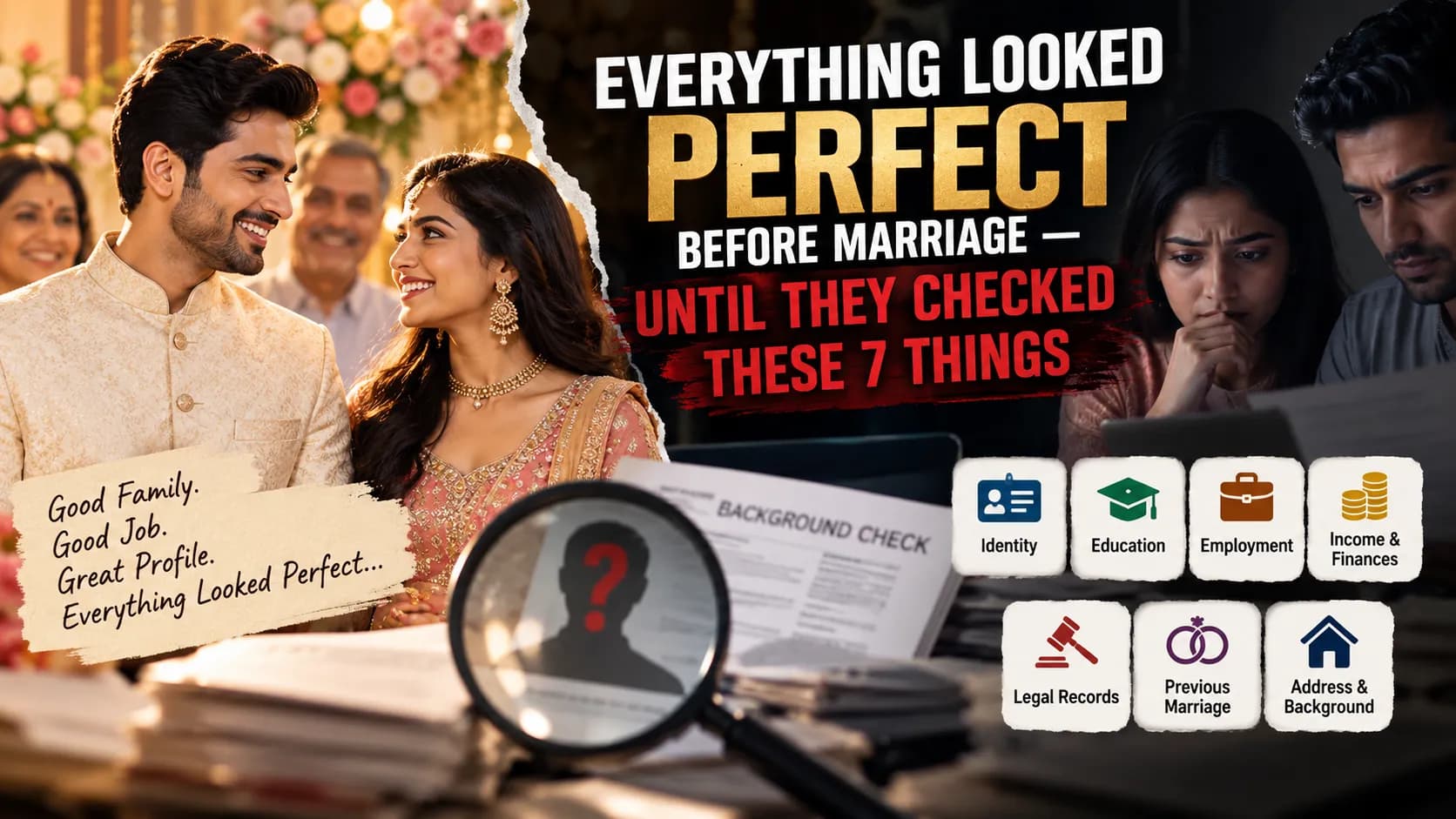
The biodata looked impressive. The photographs looked genuine. The family seemed respectable.
The person had a good education, a promising career and a convincing story. The conversations went well. The families met. Everyone seemed comfortable.
There was only one question nobody had answered: how much of the information had actually been verified?
This does not mean that every matrimonial proposal is hiding something. Most people looking for marriage are genuine, and an inconsistency is not automatically proof of fraud.
But marriage involves decisions that can affect your finances, legal status, family responsibilities and future for decades. That is why reasonable verification before marriage can be valuable.
A biodata tells you what someone says about themselves. A conversation tells you what they choose to share. Verification helps you establish which important facts can actually be supported.
Here are seven areas families should consider checking before saying yes.
1. Identity: Is the Person Actually Who They Claim to Be?
Identity is the foundation of every other verification. If the name, date of birth or identity information is incorrect, subsequent checks can become unreliable as well.
Before marriage, families may want to establish whether important identity details are consistent across the documents and information voluntarily provided by the person. Depending on the circumstances, this can include checking:
- Full legal name
- Date of birth
- Government-issued identity information
- PAN details where relevant
- Address information
- Consistency between documents
- Whether different versions of personal information have been provided
Imagine a family has spent months discussing a marriage proposal. They have verified the person's education. They have spoken to the employer. They have discussed finances. But the underlying identity information used for those checks was never properly established.
That creates a basic problem: are all these records actually connected to the same person? Identity verification should therefore come before relying heavily on other claims.
An identity mismatch does not automatically mean fraud. Names can change because of marriage, spelling differences, transliteration, documentation errors or legitimate circumstances. The purpose of verification is to identify discrepancies so they can be explained, not to automatically assume wrongdoing.
2. Education: Does the Qualification Match the Claim?
Educational qualifications are frequently included in matrimonial biodatas - an MBA from one university, a B.Tech from another, a master's degree from a named institute. But a qualification written on a biodata is still a claim until it can be supported.
Where education is important to the marriage decision, families can consider verifying:
- Institution name
- Degree or qualification
- Course
- Year of completion
- Enrollment or registration information where available
- Whether the qualification can be confirmed through the issuing institution or an appropriate verification mechanism
Educational qualifications can influence how a family understands career prospects, professional background, income expectations, social or professional status and future plans.
A person does not need an impressive degree to be a suitable life partner. The issue is accuracy. A person with an ordinary educational background who tells the truth is fundamentally different from someone who deliberately represents a qualification they do not possess.
3. Employment: Is the Job and Career History Accurate?
A good job title can make a matrimonial profile look very different. "Senior Manager at a multinational company" creates a very different impression from "working in a small organisation in an entry-level role." Neither is inherently better or worse - the important question is whether the information is accurate.
Depending on the relevance of employment to the marriage decision, verification may cover:
- Current employer
- Designation
- Employment period
- Previous employers
- Career history
- Location of employment
- Professional claims made in the biodata
Suppose someone says they have worked for the same organisation for five years, but their LinkedIn profile shows a different employment timeline. That does not prove deception - there may be an innocent explanation. But it is a reason to ask a question.
Good verification does not begin with an accusation. It begins with clarification.
4. Income and Financial Liabilities: What Does Their Financial Picture Actually Look Like?
Money is one of the most important areas to discuss before marriage, and one of the areas people can be uncomfortable verifying. A person may tell you they earn a certain amount a year, but income alone does not describe someone's financial position.
A more complete picture may involve:
- Income
- Employment stability
- Existing loans
- Outstanding liabilities
- Credit history
- Major financial commitments
- Financial responsibilities toward dependants
- Whether the stated income is consistent with available documentation
Discovering significant financial obligations only after marriage isn't just about the amount of debt. It can affect household budgeting, savings, home purchases, future borrowing, lifestyle decisions and financial responsibilities toward family members. This is why financial compatibility deserves an honest conversation before marriage.
Where appropriate and legally permissible, financial information can also be verified through consent-based processes.
A loan is not automatically a red flag. Many financially responsible people have home loans, education loans, vehicle loans, business loans or credit-card balances. The relevant question is whether important financial information has been accurately disclosed and understood by both people.
5. Criminal and Court Records: Is There Relevant Legal History?
This is one of the areas families often find difficult to discuss. Nobody wants to begin a marriage conversation by asking whether the other person has a criminal case. But when serious undisclosed legal history could materially affect someone's decision to marry, knowing the relevant facts beforehand can matter.
Depending on the verification service and jurisdiction, families may consider checks relating to:
- Court records
- Pending cases
- Relevant publicly accessible legal records
- Criminal proceedings
- Other legally verifiable information
A criminal case, complaint or proceeding should not automatically be treated as proof that someone committed an offence. Legal status matters - there is a significant difference between an allegation, an FIR, a pending proceeding, an acquittal, a conviction, and a case that has been otherwise disposed of.
A responsible verification report should present the underlying information accurately rather than turning a database result into a conclusion about someone's character. This is especially important when making decisions about marriage.
6. Previous Marriage and Marital Status
This is one of the most consequential facts that can be hidden from a prospective spouse. A person may say they've never been married - but if there has been a previous marriage, the important questions can include:
- Was there a previous marriage?
- When did it take place?
- Has it legally ended?
- Is there a divorce decree?
- Are there ongoing legal proceedings?
- Are there unresolved matrimonial obligations?
Marriage history can have significant legal and personal consequences. A previous marriage itself is not a reason to reject someone. The problem is when a material fact is intentionally concealed.
The right approach is therefore: know the history, understand the legal position, then make an informed decision.
7. Address and Background: Does the Story Match Reality?
Address verification may sound simple, but an address can reveal inconsistencies that aren't obvious from a matrimonial profile. Families may want to understand:
- Current residential address
- Permanent address
- Previous addresses where relevant
- Whether the stated location is accurate
- Whether major information about family circumstances has been consistently represented
This is particularly relevant when the two families have met primarily online or through matrimonial platforms.
A digital profile can create a polished version of someone's life. An address is one of the pieces of information that connects that profile to the real world. Again, an address discrepancy isn't necessarily evidence of wrongdoing - people move, people rent, people work in different cities, and families have multiple residences. The purpose of verification is to understand the difference, not automatically judge it.
The Bigger Problem: Families Often Verify the Person, But Not the Claims
This is where many marriage discussions go wrong. Families spend enormous amounts of time asking what kind of person he is, what kind of family she is from, whether they seem genuine. These questions matter, but they are difficult to answer objectively from conversations alone.
A person can appear genuine and still have an incorrect biodata. A family can seem respectable and still have undisclosed financial issues. A professional profile can look impressive while containing exaggerated qualifications. None of these possibilities means you should distrust everyone - it means trust and verification serve different purposes.
Trust asks: do I believe this person? Verification asks: can this important fact be supported? You need both.
What Should You Verify Before Marriage?
Here is a practical framework Indian families can use:
| Area | What to establish |
|---|---|
| Identity | Name, DOB and identity consistency |
| Education | Degree, institution and qualification |
| Employment | Employer, designation and employment history |
| Income | Stated income and appropriate supporting information |
| Finances | Loans, liabilities and relevant financial obligations |
| Legal history | Relevant court/criminal records and their actual status |
| Marriage history | Previous marriage and legal status |
| Address | Current and relevant residential information |
| Family information | Important facts that materially affect the marriage |
| Public digital presence | Relevant publicly available information, where appropriate |
The exact checks required will depend on the people involved, the information being claimed and what both parties consent to verify.
Is Marriage Verification About Not Trusting Someone?
No. Responsible verification does not have to mean spying on a prospective partner.
There is a significant difference between covertly investigating someone and both people voluntarily participating in a transparent verification process. That distinction is central to modern marriage verification.
If both sides are comfortable sharing verified information, the process can become reciprocal: "I am willing to verify myself. I am also comfortable asking you to do the same." That changes the conversation from suspicion to transparency.
Milne Se Pehle is built around this consent-based approach to marriage verification: instead of secretly investigating another person, individuals can verify themselves and share their verification information with the other side.
What If Someone Refuses Verification?
Refusing verification is not automatically proof of fraud. There can be many legitimate reasons someone may hesitate to share personal information, and privacy concerns are real.
However, if verification is important to both families, the refusal should become a conversation, not an accusation. Ask:
- What information are you uncomfortable sharing?
- Why?
- Can the scope be limited?
- Can both sides follow the same process?
- Can sensitive information be handled through an appropriate consent-based verification provider?
- What information is genuinely necessary for the marriage decision?
The objective should be reasonable transparency, not unlimited access to someone's private life.
When Should You Start Verification?
Ideally, verification should happen before a major irreversible commitment. That could mean before:
- Engagement
- Wedding planning
- Large wedding expenses
- Financial commitments
- Relocation decisions
- Joint purchases
- Major family commitments
The earlier important discrepancies are identified, the more choices everyone has. Waiting until after marriage can turn a question that could have been resolved into a much larger personal, financial or legal problem.
A Simple Rule for Families
Before saying yes, ask yourself: what important facts am I assuming rather than knowing? Then make a list.
"He works for this company." Verified or assumed?
"She has this degree." Verified or assumed?
"There are no major financial liabilities." Verified or assumed?
"There has never been a previous marriage." Verified or assumed?
"The identity documents belong to the same person." Verified or assumed?
That simple distinction can change how a family approaches matrimonial due diligence.
Verification Is Not an Accusation
This is perhaps the most important message. Verification does not mean you believe someone is lying.
You verify a property before buying it. You verify documents before signing an agreement. You verify financial information before making a major investment. Marriage deserves the same level of informed decision-making.
The objective isn't to find a reason to say no. The objective is to make sure that when you say yes, you understand what you are saying yes to.
What Milne Se Pehle Can Help You Verify
Milne Se Pehle is a consent-based marriage verification platform designed to help individuals and families verify important matrimonial information before marriage.
Depending on the verification scope, the platform covers areas such as:
- Identity
- Education
- Employment
- Income
- Financial information
- Criminal and court records
- Address
- Other relevant background information
The platform's core idea is simple: don't secretly investigate the person you may marry - verify yourself, and invite them to verify too. This approach makes verification a shared exercise in transparency rather than a covert investigation.
Frequently Asked Questions
What should I verify before marriage?
Important areas can include identity, education, employment, income, financial liabilities, relevant legal records, previous marriage history and address. The appropriate checks depend on the circumstances and should be conducted lawfully and with appropriate consent.
Is background verification before marriage legal in India?
Verification can be conducted lawfully when appropriate information is obtained and processed through legitimate means, with privacy and applicable laws respected. Families should avoid unauthorized access to private accounts, impersonation, hacking or covert surveillance. The distinction between lawful pre-matrimonial verification and intrusive or unlawful investigation matters, and is worth understanding before starting any verification.
Is a criminal record proof that someone is guilty?
No. A complaint, FIR, pending case and conviction are legally different things. Any legal-record verification should accurately distinguish the status of a case rather than treating an allegation as proof of guilt.
Should both bride and groom be verified?
A reciprocal approach can make the process more transparent. Instead of treating verification as something one family does to the other, both individuals can agree to verify relevant information about themselves.
Can I verify someone before marriage without hiring a detective?
Yes. Families can perform legitimate checks themselves or use consent-based verification services. The appropriate method depends on what needs to be verified and what information the individual agrees to provide.
Is refusing verification a red flag?
Not necessarily. A person may have legitimate privacy concerns. However, if verification is important to both sides, refusal should lead to a transparent conversation about what information can reasonably be verified and why.
When should marriage background verification be done?
It is generally more useful before major commitments such as engagement, wedding arrangements or significant financial decisions. The purpose is to identify important discrepancies while both sides still have time to discuss them.
Final Thought
A perfect biodata is not proof of a perfect person. A good conversation is not proof of complete transparency. And a verification report is not a substitute for getting to know someone.
You need all three: conversation, trust and facts.
Before you say yes to a marriage, ask one simple question: what do we actually know, and what have we only assumed?
Because sometimes, everything looks perfect until someone checks.
Ready to get verified?
Start with the Parichay tier at ₹9,999 — identity and criminal record verification in minutes.
Comments
No comments yet. Be the first.