Fake Identity in Marriage: 9 Ways to Verify Who Someone Really Is
A person can be real while important facts about them are not. Here are 9 ways to verify someone's identity before marriage - from legal identity and address to employment, education and marital history - without turning verification into an investigation.
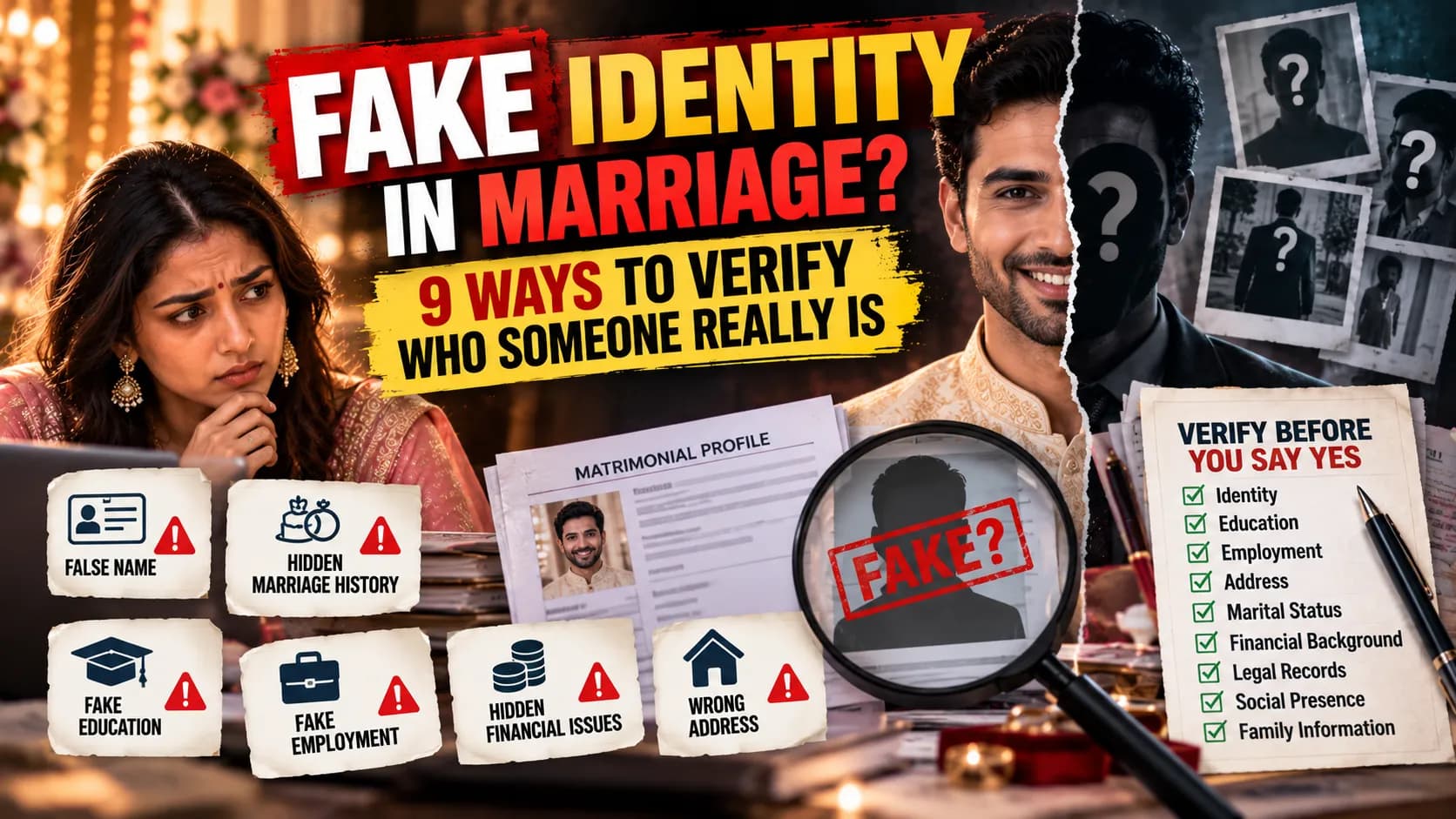
The photographs are real. The conversations are real. The family has met you. You have spoken for weeks, perhaps months. Everything seems genuine.
But there is one question that is often overlooked during a marriage proposal: how do you know that the identity and personal information being presented actually belong to the person you're planning to marry?
A fake matrimonial profile is relatively easy to imagine. But identity-related deception can be more complicated. Someone may use a different name online. A date of birth may not match. An address may be inconsistent. Educational records may not correspond with the profile. Employment information may be exaggerated. Documents may contain conflicting information. A previous marriage may not have been disclosed.
None of these inconsistencies automatically proves that someone is committing fraud. There can be legitimate explanations for many differences. But when you're making a major life decision, important discrepancies deserve to be understood before you say yes.
This guide explains nine areas that can help you establish whether the identity and background information presented by a prospective bride or groom is consistent and verifiable.
What Does "Fake Identity" Mean in a Marriage Context?
A fake identity does not necessarily mean that someone has created an entirely fictional person. Identity-related deception can take many forms. For example, someone may:
- Use a false name
- Misrepresent their age
- Provide an incorrect date of birth
- Present someone else's professional credentials
- Claim an education they did not receive
- Misrepresent their employer
- Conceal a previous marriage
- Provide an incorrect address
- Use inconsistent identity documents
- Present a significantly different personal history
There can also be completely innocent reasons for discrepancies, such as:
- Different spellings of names
- Transliteration between Hindi and English
- Name changes
- Relocation
- Old documents
- Different residential addresses
- Employer changes
- Documentation errors
That's why responsible verification should not begin with "this person is lying." It should begin with "this information doesn't match - what is the correct information?"
1. Start With the Person's Legal Identity
The first step is establishing the basic identity of the person. Depending on the circumstances and the verification process, relevant information may include:
- Full legal name
- Date of birth
- Government-issued identity information
- Current address
- Relevant identification documents
- Name variations
The purpose is to establish consistency. For example, a matrimonial profile might say "Rahul Sharma," one document says "Rahul Kumar Sharma," and another record says "Rahul K. Sharma." This does not automatically indicate a fake identity - there could be a perfectly legitimate explanation. But if the names, dates of birth and other identity details vary significantly, the discrepancy should be understood.
The key question is: can the different records reasonably be connected to the same person?
2. Check Whether the Date of Birth Is Consistent
Age can be an important part of matrimonial compatibility. It can also appear differently across matrimonial profiles, social media, identity documents and employment records.
A one-year difference may sometimes result from an error or an outdated profile, but repeated or significant differences deserve clarification. For example, a matrimonial profile might state the age as 31, a social profile as 34, and an official document a different date of birth altogether. That doesn't prove deception, but it creates a factual question: which date is correct, and can it be supported by an appropriate document?
The goal is not to embarrass someone about their age. It is to ensure that an important personal fact is accurately represented.
3. Verify the Address
Address information can be surprisingly useful when verifying someone's identity. A person may provide a current address, a permanent address, a family address, a work address and a previous residential address - these can all legitimately be different. Someone may work in Mumbai while their parents live in Lucknow, and that isn't suspicious.
However, if someone claims to permanently live at an address that they cannot reasonably connect themselves to, it may warrant further questions. Look for consistency between current residence, permanent address, family information, employment location and other relevant documentation.
An address mismatch is a question, not a conclusion.
4. Verify Educational Claims
Education is one of the most commonly presented credentials in matrimonial profiles - an MBA from a leading business school, a B.Tech from a reputed university, a master's degree from an international university. These claims can influence how families perceive someone's professional background.
Where education is materially relevant, consider verifying:
- Institution
- Qualification
- Course
- Year of completion
- Relevant enrollment or credential information
- Whether the qualification can be confirmed through an appropriate source
Why does this matter? Because there is a significant difference between "I didn't attend a prestigious university" and "I deliberately claimed a qualification I never earned." The first is simply a fact. The second could materially affect someone's decision to marry.
5. Verify Employment Claims
Professional identity is another area where matrimonial profiles can become misleading. Someone might describe themselves as a "Senior Manager at a multinational company," but what does that actually mean? Relevant information could include:
- Employer
- Designation
- Employment duration
- Industry
- Work location
- Previous employment
- Professional qualifications
This does not mean that every person needs to prove every line on their resume. The appropriate level of verification depends on how important the information is to the marriage decision.
Watch for major contradictions - for example, a profile claiming six years at a company when other information suggests the person joined just last year. There may be an explanation: perhaps they worked there previously, perhaps the profile wasn't updated, perhaps the information was simply entered incorrectly. Ask before assuming.
6. Compare the Matrimonial Profile With Other Information
Many people maintain multiple online profiles, including matrimonial profiles, LinkedIn, Instagram, Facebook, personal websites and professional directories. Public information can sometimes help identify inconsistencies - for example, a matrimonial profile describing someone as a "doctor" while a professional profile describes them as a "healthcare administrator."
Neither statement automatically proves deception. There may be context behind both descriptions. But if the differences are material, they should be discussed.
An important privacy principle applies here: only use information that you are legitimately entitled to access. Do not hack accounts, guess passwords, access private messages, impersonate someone, use spyware or obtain unlawfully accessed data. The purpose of verification is not to invade someone's private life.
7. Check Whether the Person's Family Story Is Consistent
Identity isn't limited to a name and date of birth. Matrimonial profiles often contain information about parents, siblings, family occupation, family residence, business ownership, family background and major family responsibilities.
Not every detail needs to be investigated, but important information that materially affects the marriage should be discussed openly. If someone says they are an only child and you later discover they have siblings, the explanation may be completely harmless. But if the difference relates to major undisclosed family responsibilities, it may be important to understand.
The question is: is there a material fact about the family situation that both people should know before marriage?
8. Verify Previous Marriage and Marital Status
This is one of the most sensitive identity-related areas. Someone's marital status can have significant personal and legal implications. Before marriage, it may be important to understand:
- Whether the person has been married previously
- When the previous marriage occurred
- Whether the previous marriage legally ended
- Whether a divorce decree exists where applicable
- Whether relevant matrimonial proceedings are ongoing
A previous marriage does not automatically make someone unsuitable for another marriage. The problem is concealment of a material fact. There is a major difference between "I was previously married and my divorce is legally complete" and a knowingly false "I have never been married." Transparency matters.
9. Look for Consistency Across the Entire Identity
The most useful way to think about identity verification is not as one document - think of it as a connected picture: name, date of birth, identity, education, employment, address, family information, marital history and relevant legal information.
The individual pieces should make sense together. If several important pieces contradict one another, that's when deeper clarification may become necessary.
One Mismatch Doesn't Mean a Fake Identity
This deserves its own section because identity verification can easily become unfair if handled badly.
A slightly different spelling of a name, a different city on an address, a recently changed job, or a one-year difference in an education date could all be perfectly normal.
But finding multiple different names, different dates of birth, contradictory identity information, unverifiable qualifications, a completely different employment history and an undisclosed previous marriage, together, is a different situation, one that may genuinely require explanation.
Responsible verification follows: discrepancy, clarification, supporting evidence, understanding, decision. Not: discrepancy, accusation.
Why Fake Identity Can Be Difficult to Detect Online
The internet makes it easy to create a convincing profile. A person can have professional photographs, a polished matrimonial bio, social media accounts, LinkedIn profiles, attractive career descriptions, family photographs and years of online activity. All of this can create an impression of authenticity.
But online presence does not automatically prove that every factual claim is accurate. A polished profile is still a profile. It is not necessarily a verified identity. This is particularly important when relationships begin entirely online.
Fake Profile vs Fake Identity: What's the Difference?
These terms are often used interchangeably, but they can describe different situations.
A fake matrimonial profile may involve someone pretending to be another person, stolen photographs, false personal information or a completely fabricated matrimonial account.
A misrepresented identity is different: a real person may operate the profile but provide materially false information about their age, name, education, job, income, marital status, address or family background.
The second situation can be harder to recognize because the person themselves is real. The deception may be in the information surrounding their identity.
Why People May Misrepresent Their Identity Before Marriage
There can be different reasons for inaccurate information, including:
- Wanting to appear more successful
- Hiding a previous marriage
- Hiding financial problems
- Concealing employment changes
- Social pressure
- Fear of rejection
- Deliberate fraud
- Embarrassment about personal circumstances
However, motives should not be assumed without evidence. A discrepancy tells you that something needs clarification. It does not tell you why it happened.
What Are the Biggest Identity Red Flags?
No single factor proves fraud, but multiple unexplained inconsistencies can deserve closer attention:
- Multiple unexplained names - the person consistently uses different names without a clear explanation.
- Conflicting dates of birth - important documents contain substantially different birth information.
- Unverifiable education - major qualifications cannot be reasonably confirmed.
- Unclear employment - the employer, designation or employment history repeatedly changes.
- Contradictory addresses - important residential information cannot be reconciled.
- Hidden marital history - previous marriage information is inconsistent or deliberately withheld.
- Pressure against verification - the person strongly discourages any reasonable attempt to verify important claims.
- Constantly changing stories - important facts change repeatedly when questioned.
- Requests for money before transparency - significant financial commitments are requested while basic information remains unclear.
Again, these are warning signs to investigate, not proof of wrongdoing.
What Documents Should You Verify Before Marriage?
The appropriate documents depend on the specific circumstances and the information that matters to the decision. Potential categories may include:
- Identity - relevant government-issued identity documentation.
- Education - degree, certificate or institution-related verification.
- Employment - appropriate employment documentation or verification.
- Financial information - relevant financial information where voluntarily provided and lawfully processed.
- Legal information - relevant publicly available or lawfully obtainable records.
- Marriage history - relevant legal documentation where applicable.
- Address - appropriate address documentation.
The objective should always be minimum necessary verification. You don't need access to someone's entire private life to establish a few important facts.
Should You Ask for All Documents?
Not necessarily. More information is not automatically better. A responsible process should ask: what information is actually relevant to this marriage decision?
For example, if you're verifying someone's educational qualification, you don't necessarily need unrelated personal documents. If you're discussing financial compatibility, you may need certain financial information, but not unrestricted access to someone's private accounts.
Good verification is targeted. It should be relevant, proportionate, consent-based, lawful, secure and transparent.
What If Someone Says, "I Don't Want to Share My Documents"?
That is their right to consider, especially where sensitive personal information is involved. Don't respond by trying to obtain the information secretly. Instead, ask: "What information are you comfortable verifying?" You can also propose a reciprocal approach: "I'll verify my information as well."
This can make the conversation more balanced. If an important fact cannot be verified, you then have to decide how much uncertainty you are comfortable accepting.
Should the Bride Verify the Groom? Should the Groom Verify the Bride?
Yes, on both counts. A bride can reasonably want to understand important factual information about a prospective groom before marriage, including identity, education, employment, income, financial obligations, legal history, previous marriage, address and family responsibilities. The same principle applies in reverse: a groom may reasonably want to understand the same about a prospective bride.
Verification should not become "the bride's family needs to prove everything" or "the groom's family has the right to investigate everything." A healthier approach is for both people to follow the same reasonable standard.
What About Social Media?
Social media can provide useful context, but it should not be treated as definitive proof of identity. People may use nicknames, maintain old profiles, have multiple accounts, delete old posts, use different photographs, or keep professional and personal accounts separate.
Public social-media information can therefore be one part of understanding a person's background. It should not replace formal verification where formal verification is needed.
What About AI-Generated Photos?
AI-generated and heavily edited photographs can make online identity verification more complicated. A photograph alone should not be treated as proof that the person is who they claim to be, that the photograph is recent, that the profile information is accurate, or that the person has the stated background.
This is particularly relevant for relationships that begin entirely online. A video call can help establish that you're communicating with a real person, but it still doesn't independently verify every claim about their education, employment, finances or marital history.
What If the Person Has a Very Strong Online Presence?
That can be reassuring, but it isn't the same as independent verification. Someone may have thousands of followers, years of social posts, professional profiles, family photographs and mutual connections. These can provide context, but popularity and authenticity are different things.
Digital presence is not the same as identity verification.
How to Verify Someone Before Marriage Without Becoming a Detective
You don't need to investigate every aspect of someone's life. Start with the facts that could materially affect the marriage:
- List the important claims - write down the information you are relying on.
- Separate facts from impressions - "seems successful" is an impression, "works at Company X" is a factual claim.
- Identify what needs verification - focus on material information.
- Ask for consent - explain what you want to verify and why.
- Verify through legitimate sources - use appropriate documentation or reputable verification mechanisms.
- Discuss discrepancies - give the person an opportunity to explain.
- Make your own decision - verification gives you information, you decide what it means for you.
What You Should Never Do
Even if you strongly suspect that a person's identity is false, don't cross legal or ethical boundaries. Do not:
- Hack their accounts
- Steal passwords
- Access private email
- Install spyware
- Impersonate them
- Access private messages without authorization
- Buy stolen personal data
- Create fake accounts to deceive them
- Publish unverified allegations
- Threaten or harass the person
Marriage verification should protect people, not violate their privacy.
The Most Important Question Isn't "Can I Find Something?"
A common mistake is approaching verification like an investigation where the goal is to discover a problem. That's not the ideal mindset.
The goal should be: can I establish the important facts before making this decision? If everything checks out, that's useful. If there is a discrepancy and it has a reasonable explanation, that's useful. If something important cannot be verified, that's useful information too. Verification doesn't have to produce a negative result to be valuable.
What If Everything Is Verified?
That's good, but it doesn't guarantee a successful marriage. Identity verification cannot tell you whether someone will communicate well, respect your boundaries, share your values, handle conflict, be emotionally compatible or make a good spouse. Those questions require time and personal judgment.
Verification addresses another part of the decision: are the important facts being presented accurately? You still need conversations, compatibility and trust.
Why Consent-Based Verification Is Different
Traditional investigation can create a mindset of "I need to find out what this person is hiding." Consent-based verification starts from a different place: "we both want the important facts to be clear before marriage."
That means you verify yourself, they verify themselves, both sides understand what is being checked, both sides follow the same standard, and privacy is respected. This can make verification feel less like surveillance and more like transparency.
How Milne Se Pehle Helps With Marriage Verification
Milne Se Pehle is a consent-based marriage verification platform designed to help individuals and families verify important matrimonial information before marriage.
Depending on the verification scope, relevant areas can include:
- Identity
- Education
- Employment
- Income
- Financial information
- Address
- Legal and court records
- Other relevant background information
The idea is simple: don't secretly investigate the person you may marry - verify yourself and invite them to verify too. That creates a more transparent approach to matrimonial verification.
Final Checklist: Is the Identity Consistent?
Before saying yes, ask:
- Identity - does the name match across relevant records, is the date of birth consistent, and are identity details explainable?
- Education - are important qualifications genuine and verifiable, and does the educational history make sense?
- Employment - is the current employer accurately represented, and is the career history consistent?
- Address - is the current address accurate, and are differences between current and permanent addresses explained?
- Marriage history - has the person been married previously, and if so, has the previous marriage legally ended?
- Family - are important family responsibilities disclosed?
- Legal - are there relevant legal records that should be understood?
- Transparency - are reasonable questions being answered, and is the person comfortable with mutual verification?
- Consent - is the verification process lawful, proportionate and mutually understood?
Frequently Asked Questions
How can I verify someone's identity before marriage?
Start by establishing basic identity information such as the person's legal name, date of birth and relevant identification details. Depending on the circumstances, education, employment, address and marital history can also be verified through appropriate and lawful methods.
How do I know if a matrimonial profile is fake?
Look for unexplained inconsistencies in identity, photographs, age, education, employment, address, family information and marital history. However, an inconsistency alone does not prove that a profile is fake. Ask questions and verify important claims before reaching a conclusion.
Can someone use a fake name on a matrimonial profile?
Yes, it is possible for someone to provide inaccurate identity information online. However, a different spelling or shortened name does not necessarily indicate fraud. Identity information should be assessed in context and verified appropriately.
How do I verify a groom before marriage?
Depending on the circumstances, relevant checks can include identity, education, employment, income, financial obligations, address, marital history and relevant legal records. Verification should be lawful and preferably consent-based.
How do I verify a bride before marriage?
The same principles apply. Important areas may include identity, education, employment, finances, address, marital history, relevant legal records and family responsibilities.
Is a fake matrimonial profile the same as identity fraud?
Not necessarily. A fake matrimonial profile can involve a completely fabricated profile, stolen photographs or false information. Identity-related deception can also involve a real person providing materially false information about themselves.
Can social media verify someone's identity?
Social media can provide useful context, but it should not be treated as definitive proof of identity or background. Important claims should be verified through appropriate sources.
Should I secretly investigate someone before marriage?
Secretly accessing private accounts, hacking, impersonation or obtaining unlawfully acquired information can violate privacy and the law. A consent-based verification process is a more appropriate approach for establishing relevant facts.
What if I find different names on different documents?
First determine why the names differ. Legitimate reasons can include spelling differences, transliteration, name changes or documentation errors. If the difference cannot be reasonably explained, additional verification may be appropriate.
Can identity verification guarantee that someone will be a good spouse?
No. Identity and background verification can establish certain factual information, but it cannot predict someone's future behaviour, compatibility or the success of a marriage.
Conclusion
A person can be genuine while their profile contains inaccurate information. A photograph can be real while the story around it is incomplete. A social-media account can be authentic while a professional claim is exaggerated. And a person can be exactly who they say they are while still having important parts of their history that need to be discussed.
That's why the objective of marriage verification should not be "find something wrong." It should be "know who you are saying yes to."
Ask questions. Verify important facts. Respect privacy. Give people an opportunity to explain discrepancies. And make the final decision based on information, not assumptions.
Know the facts before you say yes.
Ready to get verified?
Start with the Parichay tier at ₹9,999 — identity and criminal record verification in minutes.
Comments
No comments yet. Be the first.