15 Hidden Red Flags Before an Arranged Marriage Every Parent Should Know (2026 Guide)
Parents spend months evaluating compatibility, but in today's digital world, conversations alone may not provide a complete picture. These 15 red flags help families ask the right questions before saying yes.
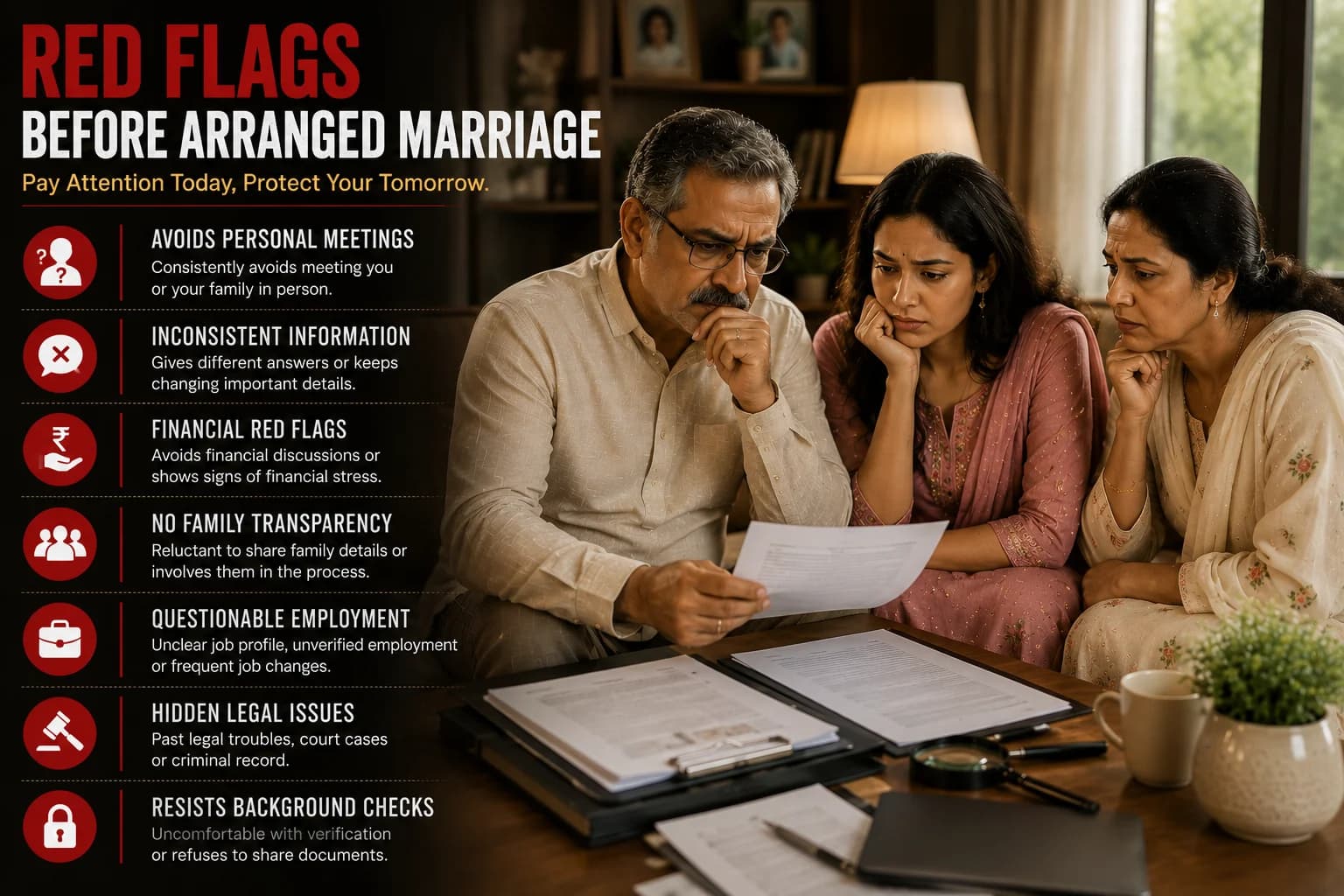
Marriage is one of the biggest decisions a family makes. In India, arranged marriages continue to bring families together through shared values, trust, and compatibility. While most marriages begin with genuine intentions, there are also cases where important facts are hidden or misrepresented.
Parents often spend months evaluating compatibility, family values, education, and traditions. However, in today's digital world, relying solely on conversations and introductions may not always provide a complete picture.
Recognising early warning signs does not mean assuming the worst about someone. It means asking the right questions, verifying important information, and making a well-informed decision before committing to a lifelong relationship.
This guide highlights 15 red flags that every family should be aware of before saying yes.
Why Red Flags Matter
A red flag is not proof of wrongdoing. Instead, it is a signal that deserves additional clarification.
Many matrimonial disputes arise not because families failed to trust, but because they never verified important claims.
Early conversations, transparency, and responsible verification can prevent misunderstandings and reduce the risk of avoidable problems later.
1. Rushing the Marriage Without a Clear Reason
One of the most common warning signs is unnecessary urgency. If someone insists that the engagement or wedding must happen immediately without a convincing explanation, take time to understand why.
Questions to ask: Why is there such urgency? Has every important discussion already taken place? Have both families had enough opportunity to know each other?
Healthy relationships rarely depend on pressure.
2. Inconsistent Personal Information
Pay attention to inconsistencies. Examples include different job titles shared with different people, changing salary figures, different versions of educational history, or conflicting family information.
Sometimes these are honest mistakes, but repeated inconsistencies deserve clarification.
3. Avoiding Questions About Employment
Employment is often an important factor in marriage discussions. If someone becomes defensive or repeatedly avoids basic questions such as: Where do you work? How long have you been employed? What is your role? it is reasonable to seek additional verification.
4. Reluctance to Introduce Family Members
Marriage joins two families, not just two individuals. If introductions are repeatedly postponed without a valid reason, understand the circumstances before moving forward.
Meeting close family members often provides valuable insight into expectations, responsibilities, and family dynamics.
5. Unwillingness to Share Basic Documentation
It is normal for families to exchange information such as educational qualifications or employment details during marriage discussions. If there is complete resistance to sharing even basic supporting information, ask why.
Transparency builds confidence.
6. Financial Discussions Are Always Avoided
Money should never be the only consideration in marriage, but it should not be treated as a taboo topic either. Important discussions include existing loans, major financial responsibilities, career plans, and lifestyle expectations.
Open conversations help both families avoid future misunderstandings.
7. Different Information on Social Media
Social media should never be treated as proof, but obvious inconsistencies deserve attention. Examples include different names, different workplaces, contradictory relationship status, or multiple unexplained accounts.
These should be discussed openly rather than ignored.
8. Extremely Limited Digital Presence
Not everyone is active online, and that alone is not suspicious. However, if someone claims a long professional career while leaving almost no verifiable digital footprint, families may wish to understand the reason.
The focus should always be on consistency rather than assumptions.
9. Pressure to Avoid Verification
Statements such as 'If you trust us, why verify anything?', 'Verification means you do not respect us', or 'Nobody else has ever asked these questions' can discourage healthy conversations.
Verification is not about disrespect. It is about making an informed decision before marriage.
10. Frequent Changes in Career History
Career growth is normal. However, repeated changes in employment history, salary claims, or work location that cannot be clearly explained should encourage further discussion.
Simple clarification often resolves confusion.
11. Unclear Marital History
This is one of the most important topics to discuss honestly. Where legally appropriate, families should ensure there are no undisclosed marriages or divorce-related issues that materially affect the decision.
Transparency protects everyone involved.
12. Family Stories Keep Changing
During multiple meetings, pay attention to whether important family details remain consistent. Examples include number of siblings, family business, property ownership, and responsibilities toward parents.
Consistency builds trust.
13. Refusal to Meet in Person
Repeated excuses to avoid meeting family members or postponing important discussions may indicate that additional clarity is needed.
Healthy relationships generally involve openness and communication.
14. Emotional Pressure
Sometimes families are encouraged to make quick decisions through emotional appeals such as 'You will lose this opportunity', 'Other proposals are waiting', or 'You must decide today'.
Major life decisions deserve thoughtful consideration. No family should feel forced into making an immediate commitment.
15. Important Questions Are Answered Vaguely
If direct questions consistently receive vague or incomplete answers, consider slowing down the process. Examples include future career plans, financial goals, living arrangements, and responsibilities toward parents.
Clear communication is one of the strongest indicators of a healthy relationship.
How Families Can Protect Themselves
Instead of focusing only on warning signs, adopt a structured verification process. A practical approach includes confirming identity, verifying employment, checking educational qualifications, discussing financial expectations, understanding family responsibilities, reviewing publicly available information where appropriate, and encouraging honest conversations between both families.
This approach promotes transparency rather than suspicion.
Verification Is About Trust, Not Doubt
Many parents hesitate to ask important questions because they fear appearing disrespectful. In reality, responsible verification demonstrates care for everyone involved.
Just as people verify property documents before buying a home or review financial details before making investments, taking reasonable steps before marriage is a responsible decision.
Verification should strengthen trust, not replace it.
Final Thoughts
Every arranged marriage begins with hope. Parents want their children to build a happy, respectful, and secure future.
Paying attention to early warning signs does not mean becoming suspicious of everyone. It means approaching one of life's biggest decisions with care, patience, and responsibility.
When important information is discussed openly and verified where appropriate, both families can move forward with greater confidence and peace of mind.
Ready to get verified?
Start with the Parichay tier at ₹9,999 — identity and criminal record verification in minutes.
Comments
No comments yet. Be the first.