Marriage Fraud in India: Common Scams, Real Warning Signs & How to Protect Your Family (2026 Guide)
Cases involving false identities, hidden marriages, fabricated careers, and financial deception have received increasing public attention. Here is what families need to know before marriage.
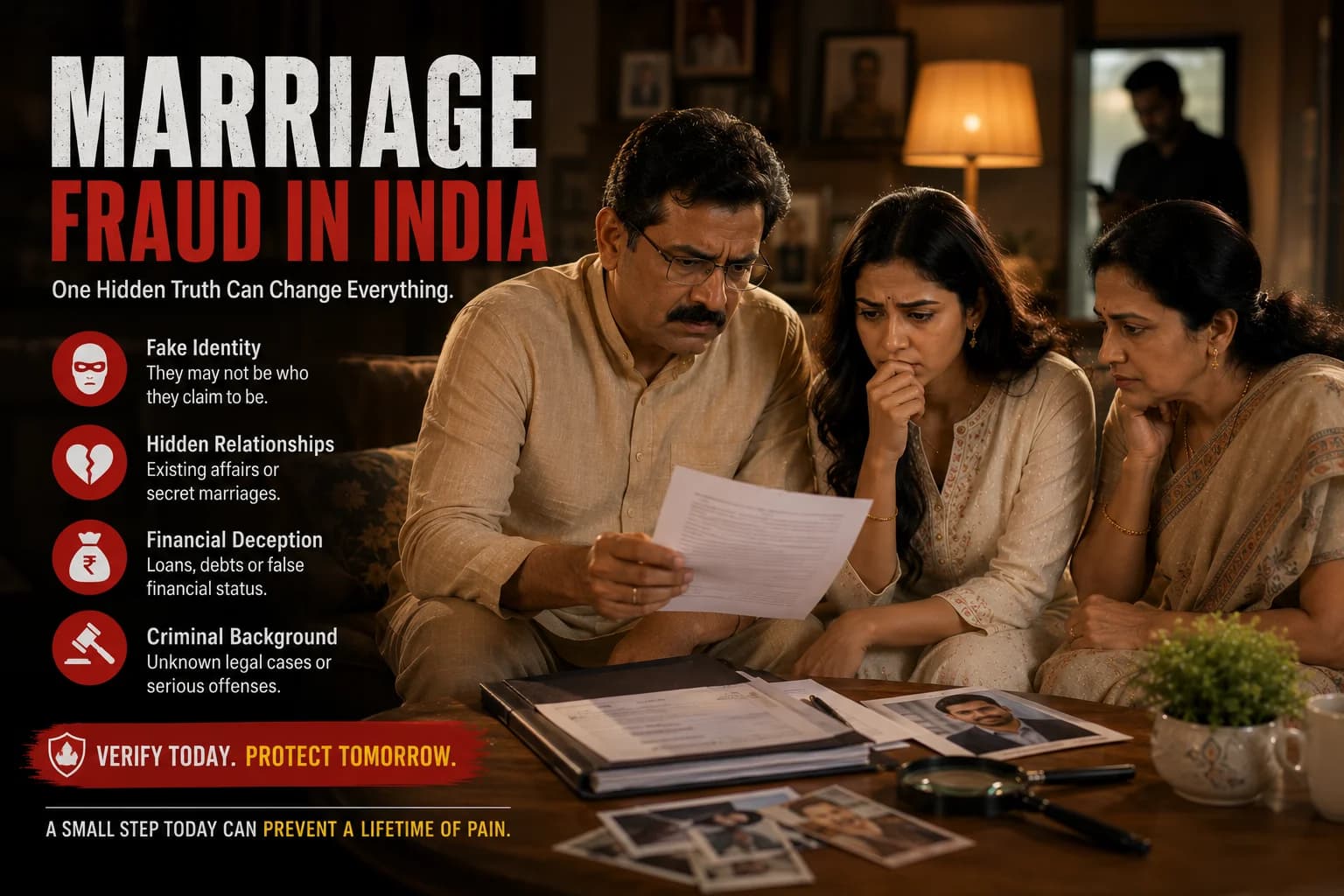
Marriage is built on trust, honesty, and mutual respect. However, as more marriages begin through matrimonial websites, social media, and digital introductions, families also face new risks. Cases involving false identities, hidden marriages, fabricated careers, financial deception, and other forms of matrimonial fraud have received increasing public attention.
Fortunately, most marriages are genuine. The goal is not to create fear, but to encourage families to make informed decisions by verifying important information before committing to a lifelong relationship.
In this guide, you will learn what marriage fraud is, the most common warning signs, practical prevention strategies, and how ethical pre-marriage verification can help reduce unnecessary risks.
What Is Marriage Fraud?
Marriage fraud occurs when a person intentionally misrepresents important information to persuade another person or family to agree to a marriage.
The concealed information may involve identity, marital status, employment, education, financial situation, criminal history, family background, or immigration status in some NRI cases.
Not every misunderstanding is fraud. Honest mistakes and communication gaps can happen. Fraud generally involves deliberate deception about facts that are important to the marriage decision.
Why Marriage Fraud Is Becoming More Common
Several factors have changed how marriages begin today: online matrimonial platforms, social media introductions, long-distance relationships, NRI proposals, limited community references, and busy professional lifestyles.
While these developments have expanded opportunities to meet compatible partners, they have also made independent verification more important.
1. Fake Employment Claims
One of the most common forms of deception involves employment. Examples include claiming to work for a company where the person has never been employed, exaggerating job titles or seniority, or misrepresenting salary or professional achievements.
Employment verification can help confirm factual information before marriage.
2. False Educational Qualifications
Some individuals falsely claim degrees, certifications, or prestigious institutions to appear more attractive as a marriage prospect.
Families should verify the degree, institution, graduation year, and professional certifications where relevant.
3. Hidden Previous Marriage
A previous marriage, divorce, or ongoing matrimonial dispute may be concealed from the other family.
Honest disclosure allows both parties to make informed decisions. This is one of the most serious categories of matrimonial misrepresentation in India.
4. Concealing Significant Financial Liabilities
Financial transparency is essential. Potential concerns include large loans, heavy debts, business liabilities, and ongoing legal financial disputes.
Discussing financial expectations before marriage reduces future misunderstandings and helps both families begin with realistic expectations.
5. Fake Government Job Claims
Government employment is often considered highly desirable in matrimonial discussions. Some fraud cases involve fake appointment letters, false departmental claims, forged identity cards, or misrepresented job roles.
Independent verification can help confirm employment details before families proceed.
6. Identity Misrepresentation
Examples include using another person's identity, providing a false age, incorrect address, fake documents, or maintaining multiple identities across different platforms.
Identity verification is one of the most fundamental checks before marriage and can be completed quickly using government sources.
7. Fake Matrimonial Profiles
Some online profiles may contain exaggerated or inaccurate information. Possible warning signs include professional photographs with little personal detail, inconsistent information across platforms, refusal to meet family members, or reluctance to answer basic questions.
A profile should always be treated as a starting point, not as proof. Verification provides a more reliable picture.
8. Hidden Criminal Proceedings
Where legally appropriate and based on publicly available information, understanding whether significant criminal proceedings exist may be relevant to a marriage decision.
India's eCourt records across 3,300+ districts are publicly accessible. Families should rely only on lawful sources of information and avoid assumptions.
9. Financial Exploitation Before Marriage
Some frauds involve repeated requests for money before marriage. Examples include fabricated medical emergencies, visa expenses, business investment requests, or wedding-related advances.
Families should exercise caution before transferring money based solely on verbal assurances, particularly in cases where the families have not met in person.
10. NRI Marriage Misrepresentation
NRI marriages often involve additional complexities such as immigration status, overseas employment claims, residency representations, or existing relationships abroad.
Extra diligence may be appropriate when information is difficult to verify independently due to distance or limited shared contacts.
Warning Signs Every Family Should Watch For
While every situation is different, consider slowing down the process if you notice: pressure to finalise the marriage quickly, reluctance to answer reasonable questions, conflicting information shared over time, refusal to introduce close family members, avoidance of employment discussions, unexplained financial secrecy, multiple inconsistent social media profiles, or requests for money before marriage.
These signs do not prove fraud but indicate that further clarification may be helpful before proceeding.
How Families Can Protect Themselves
Verify identity through government-issued documents where appropriate. Confirm the person's current role, employer, and professional background. Verify degrees and educational qualifications whenever they influence the marriage decision.
Have open conversations about income, loans, future goals, and shared responsibilities to establish realistic expectations. Spend time meeting family members together, as this often reveals insights that formal meetings cannot.
Encourage transparency throughout the process. Questions asked respectfully should not be viewed as disrespect. Healthy relationships are built on openness.
Is Pre-Marriage Verification Legal?
Pre-marriage verification should always be conducted ethically, lawfully, and with respect for privacy and applicable legal requirements. The objective is to verify factual information relevant to a marriage decision, not to invade someone's private life.
Families should avoid unlawful surveillance or unauthorised access to personal information. Consent-based self-verification, where the individual verifies their own records and shares the result voluntarily, is both legal and ethically sound.
What Can Be Verified?
Depending on the circumstances and applicable laws, verification may include identity, employment, education, address, publicly available records, and consistency of information shared during marriage discussions.
The scope should always respect privacy and legal boundaries. The goal is informed decision-making, not surveillance.
Final Thoughts
Marriage should begin with confidence, not uncertainty. Most people entering marriage are honest and sincere. Nevertheless, taking reasonable steps to verify important information protects everyone involved and encourages transparency from the beginning.
Verification is not about assuming the worst. It is about ensuring that one of life's most important decisions is made with clarity, honesty, and mutual trust.
Ready to get verified?
Start with the Parichay tier at ₹9,999 — identity and criminal record verification in minutes.
Comments
No comments yet. Be the first.